Functional Inspection
100% tested on professional platforms to ensure stable performance.
Vibro-Meter ABB007 204-007-000-102 is a NANKMOS industrial automation product record Listed under Other series series and Business & Industrial > Automation, Control & Flow Devices. Confirm condition, availability, lead time, compatibility and documentation by email inquiry.
Brand names are used for identification only.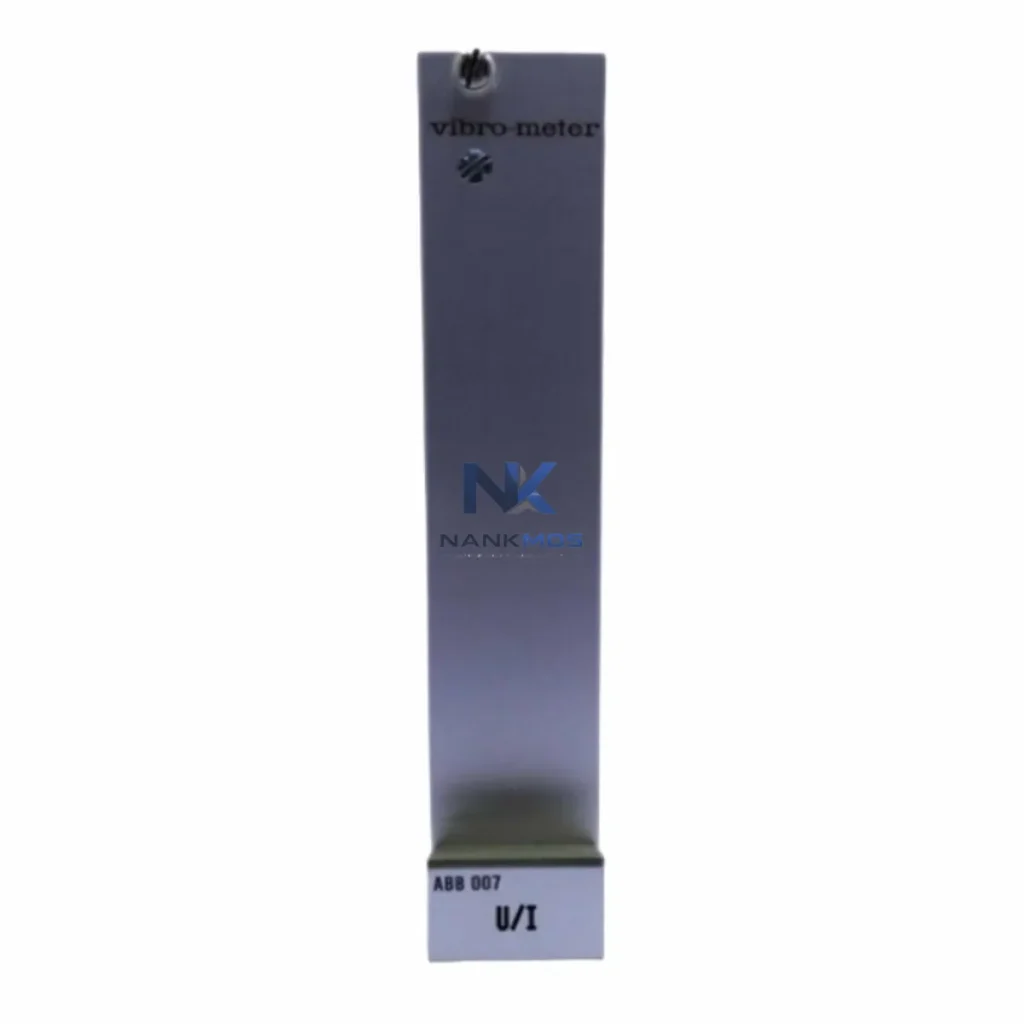
Vibro-Meter ABB007 204-007-000-102 is a NANKMOS industrial automation product record Listed under Other series series and Business & Industrial > Automation, Control & Flow Devices. Confirm condition, availability, lead time, compatibility and documentation by email inquiry.
| Manufacturer | Vibro-Meter |
|---|---|
| Application | Industrial Automation Maintenance |
| Part Number / Model | ABB007 204-007-000-102 |
| Compatible System | Confirmed by inquiry |
| Condition Options | To Confirm |
| Module Type | Automation, Control & Flow Devices |
| Warranty | 12 Months |
| Packaging | Anti-static Bag / Secure Box |
| Shipping Methods | DHL / FedEx / UPS / Air / Sea |
| Availability | To Confirm |
| Lead Time | To Confirm |
| Documentation | Part number and revision checked before quote |
The VIBRO-METER 007-204-007-000-102 is a precision signal conditioning and condition monitoring module within the VM600 platform, engineered to serve as a critical data link between rotating machinery, field sensors, and upper-level automation systems. In modern smart factory environments where unplanned downtime translates directly into production loss, this module delivers continuous, high-fidelity vibration and process data across the full automation stack — from raw sensor signals at the machine level through to SCADA dashboards and enterprise MES platforms. Its role in the industrial data chain is not merely signal acquisition; it is the intelligent bridge that transforms analog vibration data into structured, actionable network information.
Designed for integration within the VM600 rack-based architecture, the 007-204-007-000-102 module accepts inputs from proximity probes, velocity transducers, and accelerometers mounted on turbines, compressors, pumps, and motors. These raw analog signals are conditioned, filtered, and converted into digital process values that can be transmitted upstream via the VM600 communication infrastructure. When paired with the VM600 CMC16 communication module or the MPC4 machinery protection card, the system forms a complete condition monitoring node capable of feeding real-time vibration amplitude, phase, gap voltage, and alarm status data into Modbus TCP/IP, PROFIBUS DP, or OPC-UA networks — ensuring seamless compatibility with Siemens S7-300/S7-400 PLCs, ABB AC500 controllers, and Honeywell Experion PKS DCS platforms.
Within a connected factory data flow, the 007-204-007-000-102 occupies the signal conditioning layer immediately above the sensor tier. Vibration transducers and eddy-current probes feed raw millivolt or milliamp signals into this module, where onboard circuitry applies the correct excitation voltage, signal buffering, and integration or differentiation functions required to produce calibrated displacement, velocity, or acceleration outputs. These conditioned values are then passed to the VM600 rack backplane, where the CMC16 communication card aggregates data from multiple monitoring channels and packages it for Ethernet-based transmission. A Moxa NPort 5150 serial-to-Ethernet gateway or a Westermo industrial switch can extend this data path across plant-wide fiber or copper Ethernet infrastructure, delivering sub-100ms latency updates to OSIsoft PI historians, Wonderware InTouch SCADA, or GE iFIX HMI stations.
Remote diagnostics capability is a defining strength of the VM600 platform when the 007-204-007-000-102 is deployed as part of a networked condition monitoring architecture. Maintenance engineers can access live vibration spectra, trend data, and alarm logs from any networked workstation without requiring physical access to the control cabinet. When a bearing defect frequency appears in the vibration spectrum or an overall vibration level crosses a pre-configured danger threshold, the module triggers both a local relay output and a network alarm message simultaneously — enabling the SCADA system to log the event, notify the on-call engineer via SMS gateway, and initiate a controlled shutdown sequence through the connected PLC if required. This closed-loop alarm response architecture eliminates the data gaps that traditionally exist between field instrumentation and plant control systems.
For facilities operating mixed-protocol environments — a common challenge in brownfield smart factory upgrades — the VM600 communication layer supports protocol bridging between legacy serial Modbus RTU devices and modern Ethernet-based PROFINET or EtherNet/IP networks. An Anybus X-gateway or HMS Industrial Networks communicator installed alongside the VM600 rack can translate VM600 Modbus TCP data into PROFINET IO frames consumable by a Siemens ET 200SP remote I/O station or a Beckhoff EK1100 EtherCAT coupler, ensuring that condition monitoring data flows without interruption into the broader automation network. This protocol flexibility is essential for plants where the condition monitoring system must coexist with existing PLC programs, safety instrumented systems, and energy management platforms without requiring a full network redesign.
Data visualization and trending are supported through the VM600's native software tools and through standard OPC-UA server interfaces that expose all monitored parameters to third-party SCADA and historian platforms. Operators viewing a Wonderware System Platform or Ignition SCADA screen can observe real-time vibration waterfall plots, orbit diagrams, and trend charts sourced directly from the 007-204-007-000-102 module's measurement channels. When integrated with an edge computing gateway such as a Siemens SIMATIC IPC or a Moxa UC-8112 industrial computer, the VM600 data stream can be pre-processed locally — applying FFT analysis, envelope detection, and bearing defect frequency calculations — before forwarding condensed diagnostic results to cloud-based asset management platforms. This edge-to-cloud architecture reduces network bandwidth consumption while preserving the full diagnostic resolution needed for predictive maintenance decisions.
Every 007-204-007-000-102 unit supplied by NANKMOS is sourced from verified supply channels, subjected to pre-shipment functional testing to confirm signal conditioning accuracy and communication interface integrity, and dispatched with a 12-month warranty covering manufacturing defects and operational failures under normal industrial service conditions. Global logistics support ensures rapid delivery to automation integrators, OEM machine builders, and end-user maintenance teams across Asia, Europe, and the Americas. In-stock availability minimizes project lead times for both new installations and emergency replacement scenarios where an unplanned module failure threatens production continuity.
A complete smart factory condition monitoring data chain built around the VIBRO-METER 007-204-007-000-102 begins at the machine shaft, where Bently Nevada 3300 XL proximity probes or Metrix ST5484E velocity transducers capture raw vibration signals. These signals enter the 007-204-007-000-102 module's input channels, where precision signal conditioning circuits apply the correct excitation, buffering, and mathematical integration required to produce calibrated engineering-unit outputs. The conditioned data travels across the VM600 rack backplane to the VM600 CMC16 communication module, which aggregates measurements from up to 16 monitoring channels and presents them as Modbus TCP registers or OPC-UA nodes on the plant Ethernet network.
A Westermo Lynx 206-F2G managed industrial switch routes this Ethernet traffic across the plant fiber backbone to a Siemens S7-400H redundant PLC, which uses the vibration data as process inputs for load-shedding logic and protective interlock sequences. Simultaneously, a Moxa UC-8112 edge gateway subscribes to the OPC-UA data stream, performs local FFT and envelope analysis, and forwards condensed diagnostic results to an Ignition SCADA server. HMI panels — such as a Siemens TP1200 Comfort or a Weintek MT8102iE — display real-time vibration trends and alarm states to operators on the plant floor. An ABB Ability™ Asset Health Center or OSIsoft PI Asset Framework historian archives all time-series vibration data for long-term trend analysis and regulatory compliance reporting. The complete data path — from rotating shaft to enterprise dashboard — operates with end-to-end latency under 500ms, supporting both real-time protection and predictive maintenance workflows within a unified smart factory network.
Industrial sites that rely on standalone vibration monitors without network connectivity face persistent data gaps: alarm events go unlogged, vibration trends are invisible to SCADA operators, and maintenance teams must physically visit each machine to read local displays. The VIBRO-METER 007-204-007-000-102, integrated within the VM600 platform, eliminates these gaps by converting isolated machine-level measurements into structured network data accessible from any point in the automation hierarchy.
Protocol fragmentation is a common barrier in brownfield upgrades, where legacy Modbus RTU devices must coexist with modern PROFINET or EtherNet/IP networks. The VM600 communication architecture, combined with protocol gateway devices such as the Anybus Communicator or Moxa MGate MB3480, bridges these protocol boundaries without requiring PLC program modifications or network redesign. Data silos between the condition monitoring system and the plant DCS are resolved by exposing all VM600 measurement channels as standard OPC-UA nodes, enabling direct subscription by Honeywell Experion, Emerson DeltaV, or Yokogawa CENTUM VP systems.
Remote monitoring gaps — particularly acute for unmanned substations, offshore platforms, and remote compressor stations — are addressed through the VM600's network alarm output capability. When a monitored parameter crosses a danger threshold, the system simultaneously activates a hardwired relay, generates a Modbus exception response, and publishes an OPC-UA alarm event, ensuring that the alarm reaches the SCADA alarm management system regardless of which communication path is active. This redundant alarm propagation architecture supports IEC 62682 alarm management compliance and reduces mean time to respond (MTTR) for critical rotating equipment faults.
Q1: What communication protocols does the VIBRO-METER VM600 system support when using the 007-204-007-000-102 module? The VM600 platform supports Modbus TCP/IP, Modbus RTU, PROFIBUS DP, and OPC-UA communication protocols when equipped with the CMC16 communication module. This enables direct integration with Siemens, ABB, Honeywell, Emerson, and Yokogawa control systems without requiring additional protocol converters in most standard automation architectures.
Q2: What is the typical network latency for vibration data transmission from the 007-204-007-000-102 to a SCADA system? Under standard Ethernet network conditions with a managed industrial switch, end-to-end latency from signal conditioning output to SCADA data update is typically under 100ms for Modbus TCP polling cycles configured at 100ms intervals. OPC-UA subscription-based communication can achieve comparable or lower latency depending on the configured publishing interval and network load.
Q3: Can the VM600 007-204-007-000-102 module be integrated into an existing PROFIBUS DP network alongside other field devices? Yes. When the VM600 rack is equipped with a PROFIBUS DP communication card, the 007-204-007-000-102 module's measurement data is mapped to PROFIBUS DP process data objects and made available to any PROFIBUS DP master, including Siemens S7-300/S7-400 PLCs with CP 342-5 communication processors or ABB AC500 PLCs with PROFIBUS DP master modules. GSD file configuration is required in the PLC engineering tool.
Q4: What pre-shipment testing and warranty coverage does NANKMOS provide for the 007-204-007-000-102? Every unit undergoes functional verification testing prior to shipment, confirming signal conditioning accuracy, relay output operation, and communication interface integrity. NANKMOS provides a 12-month warranty covering manufacturing defects and operational failures under normal industrial service conditions, with global logistics support for rapid replacement in the event of a warranty claim.
Functional Inspection100% tested on professional platforms to ensure stable performance.
 Anti-static Packaging
Modules are packed in anti-static bags to prevent electrostatic damage.
 Secure Export Packing
Cushion protection and strong cartons ensure safe transportation.
 Worldwide Shipping
Global logistics network supports air, sea and express delivery.
 Documentation Check
Part number, revision and compatibility verified before shipment.
 After-sales Support
Professional technical support to help resolve your issues.