
Industry Applications
AMR Charging Faults: Is the Spare on the Robot or at the Dock?
When an AMR stops charging, distinguish the fixed dock from the vehicle battery. Use dock IDs and fleet events to scope the right replacement RFQ.
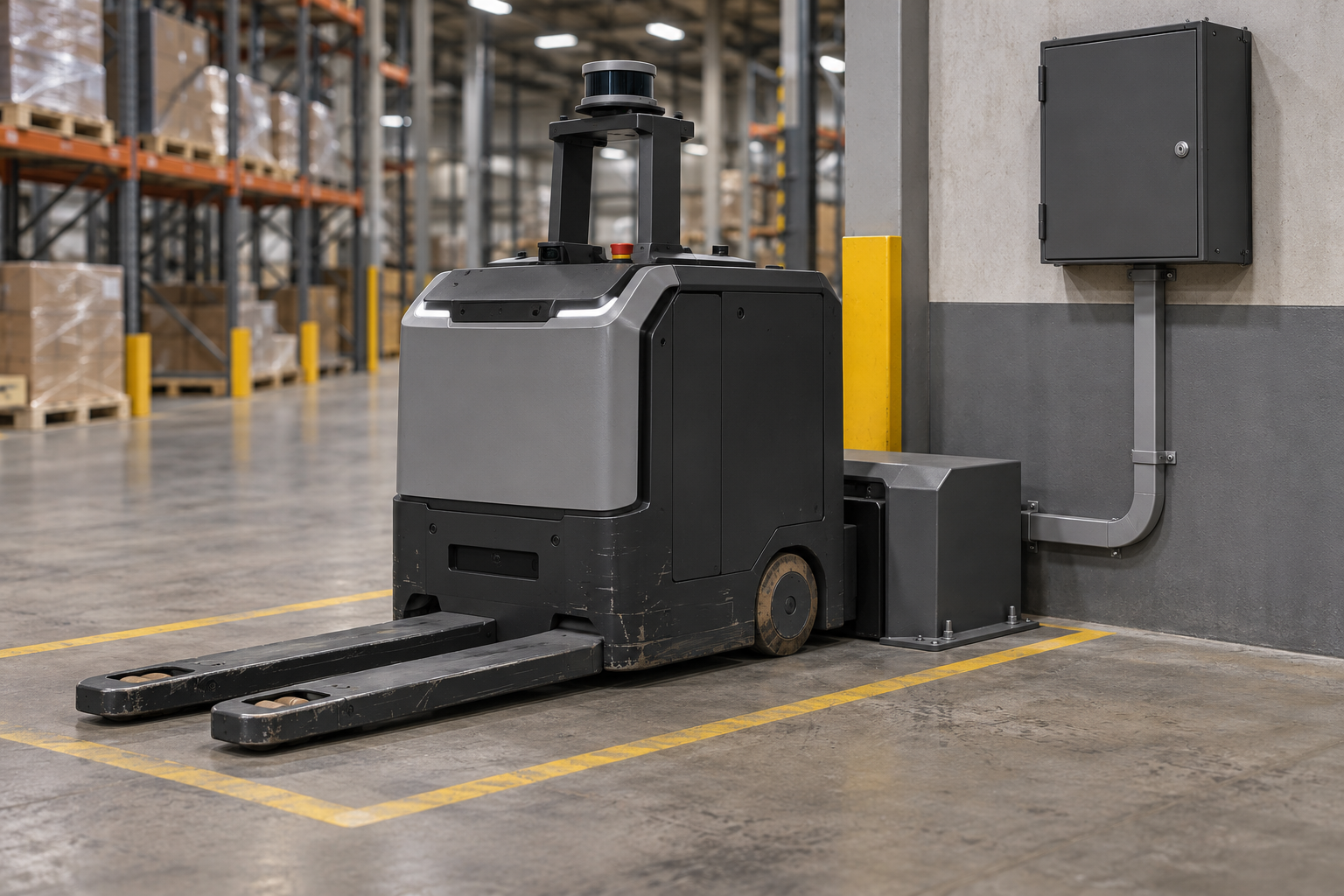
Three warehouse robots stop charging at Bay 4. A spare battery might seem like the fastest thing to order, but all three vehicles share one piece of equipment at that bay: the fixed charging station. Before the request goes to purchasing, find out whether the reported failure follows the bay or the vehicle.
On November 18, Rockwell Automation announced an agreement to acquire AGILOX, describing its forklift-style autonomous mobile robots (AMRs) as complementary to Rockwell’s OTTO flatbed platform. The transaction is subject to closing conditions and regulatory approval. The announcement does not establish shared chargers, batteries or service procedures between those fleets.
Use existing fleet records to narrow the scope
Compare recent successful and failed charge sessions by vehicle ID, bay ID and time. If several vehicles charged normally at other approved bays but logged failures at the same bay, ask the service team to investigate what they shared at that location. That may include the dock assembly, its supply or a docking alignment problem. If the same vehicle logged failures at several approved bays while other vehicles charged there, ask the team to investigate the vehicle side. The battery is one possibility; the vehicle’s charging interface is another.
Record whether the vehicle was unable to reach the bay, reached it but did not establish a charge session, or started charging and stopped early. These are different observations. Use the records to route the service request, not to declare a component failed. If the logs do not distinguish the cases, do not swap chargers or batteries as an informal test.
Identify the dock as its own asset
As a technical reference, the AGILOX OCF datasheet, version 03/2023, lists a mobile charging device and separate standard and fast stationary stations. The stationary options have different input requirements. The takeaway is that even a vehicle-family name is too broad for a charger RFQ. The approved parts list for the installed bay, not the example datasheet, should determine what gets quoted.
For a dock-side request, send the bay ID and station assembly number and revision, then state whether you need a complete station or a service component identified by the maintenance team. For a vehicle-side request, send the vehicle model and serial number and the approved assembly part number if known. Keep the two requests separate when the cause remains unresolved. That makes it easier to compare a quote for a station against a quote for a battery or vehicle-side assembly without treating them as alternatives.
See our industry applications guides or the related article on identifying the motor–converter pair on an AGV. If you already have the equipment references, send them to NANKMOS with the requested scope. Confirm compatibility, condition and lead time before ordering.
Related guides
View all guides
Machine Vision False Rejects: Check the Lighting Before the Camera
When a reflective part fails inspection, compare reference images before ordering a camera. Learn when to scope the light, controller or mounting instead.
Read guide
Servo Drive Spares: EtherCAT Is Not the Encoder Interface
An EtherCAT drive can still be the wrong spare. Learn how to verify the motor encoder protocol, feedback cable and exact drive variant before ordering.
Read guide
CENTUM R7.02: An Estimate Is Not a Field Measurement
Yokogawa’s CENTUM R7.02 adds AI Estimation. See how to distinguish model outputs, transmitter readings and laboratory results before ordering a spare.
Read guide
Rockwell LogixEdge: One Device, Two Change Approvals
Rockwell LogixEdge brings machine control and edge software onto one device. Define who approves each change and what must be verified before release.
Read guideSend your part number, photos or nameplate.
Our team will verify, check availability, and reply with options within 24 hours.
[email protected]+86 18359268345WhatsApp