Functional Inspection
100% tested on professional platforms to ensure stable performance.
Mitsubishi Electric A1SJ71AR2 is a NANKMOS industrial automation product record Listed under A1SJ series and Business & Industrial > Automation, Control & Flow Devices > Programmable Logic Controllers. Confirm condition, availability, lead time, compatibility and documentation by email inquiry.
Brand names are used for identification only.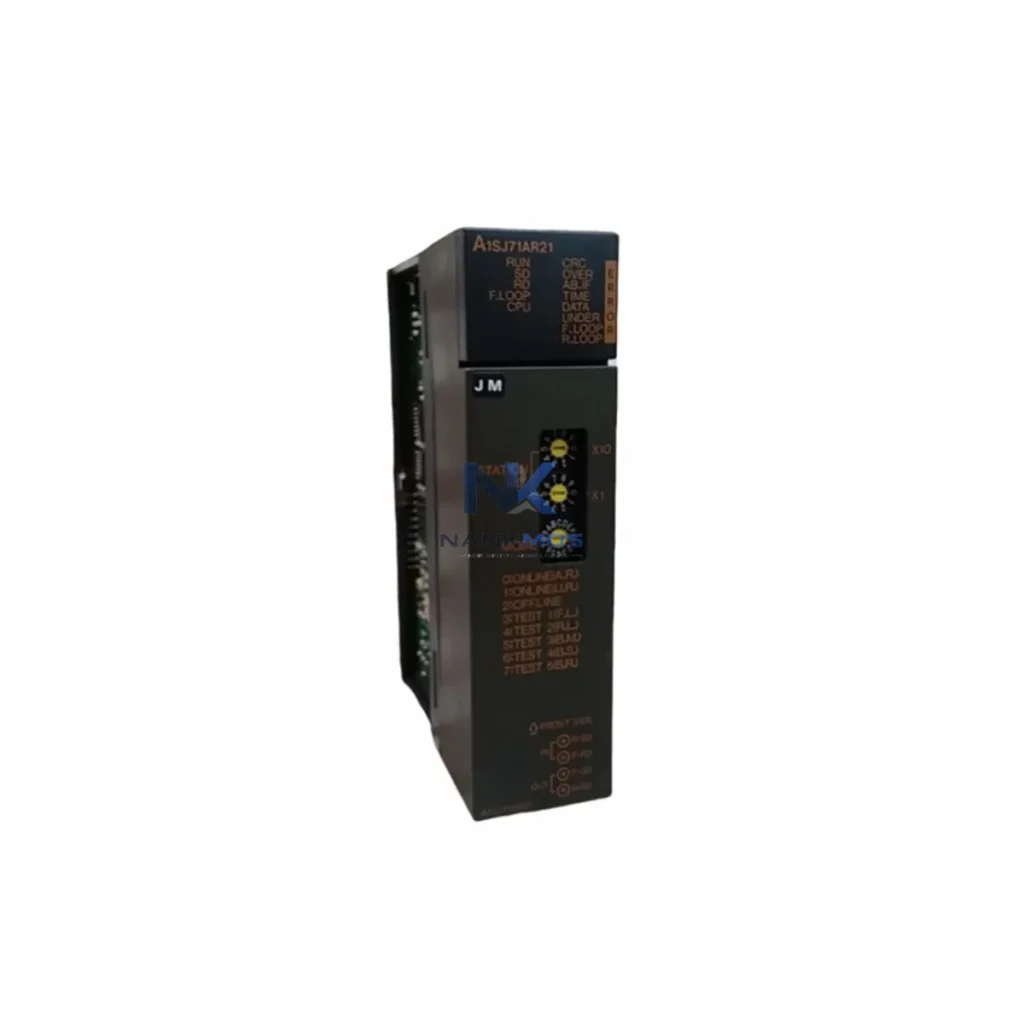
Mitsubishi Electric A1SJ71AR2 is a NANKMOS industrial automation product record Listed under A1SJ series and Business & Industrial > Automation, Control & Flow Devices > Programmable Logic Controllers. Confirm condition, availability, lead time, compatibility and documentation by email inquiry.
| Manufacturer | Mitsubishi Electric |
|---|---|
| Application | Controller Processing & System Control |
| Part Number / Model | A1SJ71AR2 |
| Compatible System | A1SJ |
| Series | A1SJ |
| Condition Options | To Confirm |
| Module Type | Controller / CPU Module |
| Warranty | 12 Months |
| Packaging | Anti-static Bag / Secure Box |
| Shipping Methods | DHL / FedEx / UPS / Air / Sea |
| Availability | To Confirm |
| Lead Time | To Confirm |
| Documentation | Part number and revision checked before quote |
The Mitsubishi Electric A1SJ71AR2 is a MELSECNET/10 data link module engineered for the MELSEC-A series PLC platform, delivering deterministic, high-speed network communication across distributed automation architectures. Designed for demanding industrial environments, the A1SJ71AR2 serves as a critical bridge between field-level devices and upper-layer control and monitoring systems — enabling seamless data flow from signal acquisition through to SCADA visualisation and remote diagnostics.
In modern smart factory deployments, the A1SJ71AR2 functions as the backbone of a multi-node communication network, connecting MELSEC-A series CPU modules with remote I/O stations, HMI panels, engineering workstations, and supervisory control platforms. Its MELSECNET/10 protocol supports both optical and coaxial ring topologies, providing redundancy and fault tolerance essential for continuous production environments.
The A1SJ71AR2 sits at the heart of a layered industrial communication architecture. At the field level, sensors, actuators, and remote I/O modules — such as the Mitsubishi A1S62RD4 temperature input module and A1SX40 digital input module — feed real-time process data into the MELSEC-A CPU via the local bus. The A1SJ71AR2 then transmits this aggregated data across the MELSECNET/10 network to peer PLC stations, enabling coordinated multi-axis control and synchronised production sequencing.
Within the same network segment, the A1SJ71AR2 communicates with Mitsubishi GOT series HMI panels, providing operators with live process visualisation, alarm acknowledgement, and parameter adjustment without interrupting the control cycle. For SCADA integration, the module interfaces with upper-layer systems via the MELSECNET/10 host station — typically a Mitsubishi Q series or A series master module — which aggregates data from all network nodes and forwards it to SCADA platforms such as Citect, iFIX, or Wonderware through OPC-DA or dedicated Mitsubishi communication drivers.
In distributed manufacturing lines, the A1SJ71AR2 enables peer-to-peer data sharing between multiple MELSEC-A PLCs controlling different production zones. For example, a conveyor control PLC can share belt speed and fault status with a downstream packaging PLC in real time, eliminating the latency and reliability risks of hardwired interlocks. This architecture also supports integration with Mitsubishi FR-A series variable frequency drives via dedicated I/O modules, allowing the SCADA system to monitor drive load, frequency setpoint, and fault codes across the entire production line.
Edge connectivity is achieved by pairing the A1SJ71AR2 with an industrial Ethernet gateway — such as a Moxa NPort or Mitsubishi MES interface module — which bridges MELSECNET/10 data to higher-level MES and ERP systems. This enables production KPI dashboards, OEE tracking, and predictive maintenance analytics to be driven directly from PLC-level data, closing the loop between the shop floor and the enterprise.
For remote diagnostics, the A1SJ71AR2 supports network-level error detection and station status monitoring. Maintenance engineers can interrogate individual node status, cyclic transmission errors, and link scan times from a central engineering workstation running Mitsubishi GX Developer or GX Works software, without requiring physical access to the field panel. This capability is particularly valuable in geographically distributed facilities where minimising on-site maintenance visits is a key operational priority.
Protocol Fragmentation: Many legacy automation sites operate with a mix of MELSECNET/10, CC-Link, and serial RS-232/RS-485 devices. The A1SJ71AR2 addresses MELSECNET/10 segments directly, and when combined with a Mitsubishi AJ65BT-R2 CC-Link/serial gateway, enables unified data collection across heterogeneous protocol environments — eliminating data silos between older MELSEC-A systems and newer CC-Link or Ethernet-based infrastructure.
Data Islands and Production Transparency: Without a reliable network backbone, production data from individual machine PLCs remains isolated. The A1SJ71AR2 enables all MELSEC-A nodes to share cyclic data in a single network scan, making real-time production counts, fault codes, and process parameters visible to SCADA and MES systems simultaneously — transforming isolated machine data into a unified production intelligence layer.
Remote Monitoring and Alarm Tracking: The module's network-level diagnostics allow SCADA systems to detect communication faults, station dropouts, and transmission errors in real time. Alarm events are timestamped and logged at the SCADA level, enabling root-cause analysis and trend-based maintenance scheduling without relying on manual inspection of individual PLC fault registers.
System Expansion: The MELSECNET/10 ring topology supported by the A1SJ71AR2 allows new PLC stations and remote I/O nodes to be added to the network without disrupting existing communication. This makes it straightforward to expand production lines, add new machine cells, or integrate additional monitoring points as factory capacity grows — protecting the original network investment while supporting incremental automation upgrades.
Q1: What is the typical network scan time for the A1SJ71AR2 in a MELSECNET/10 ring configuration?The MELSECNET/10 link scan time depends on the number of stations and the volume of cyclic data points configured. In a standard 16-station ring with typical I/O point counts, link scan times are in the range of 5–20 ms, providing deterministic data refresh rates suitable for real-time process control and SCADA polling.
Q2: Is the A1SJ71AR2 compatible with both optical and coaxial MELSECNET/10 networks?The A1SJ71AR2 is designed for coaxial MELSECNET/10 networks. For optical ring configurations, Mitsubishi Electric offers the A1SJ71AT21B variant. Both modules share the same software configuration interface via GX Developer, simplifying migration between network media types.
Q3: Can the A1SJ71AR2 be integrated with modern SCADA platforms that use OPC-UA or Ethernet-based protocols?The A1SJ71AR2 communicates natively over MELSECNET/10. Integration with OPC-UA or Ethernet SCADA platforms requires a protocol gateway — such as a Mitsubishi MES interface module or a third-party OPC server with MELSECNET/10 driver support. This gateway translates MELSECNET/10 cyclic data into OPC tags accessible by any compliant SCADA or historian platform.
Q4: What does the 12-month warranty cover, and is pre-shipment testing included?Every A1SJ71AR2 unit supplied by NANKMOS is covered by a 12-month warranty against manufacturing defects and functional failure under normal operating conditions. Each unit undergoes pre-shipment functional testing to verify communication link establishment, cyclic data transfer, and module self-diagnostics before dispatch. Test documentation is available upon request.
Functional Inspection100% tested on professional platforms to ensure stable performance.
 Anti-static Packaging
Modules are packed in anti-static bags to prevent electrostatic damage.
 Secure Export Packing
Cushion protection and strong cartons ensure safe transportation.
 Worldwide Shipping
Global logistics network supports air, sea and express delivery.
 Documentation Check
Part number, revision and compatibility verified before shipment.
 After-sales Support
Professional technical support to help resolve your issues.