
Product Systems
DeltaV IQ Controller: How Server-Based Control Changes Spare Planning
Emerson’s DeltaV IQ announcement highlights server-based control. Here is how maintenance teams can distinguish host, software, redundancy and physical-controller support boundaries.
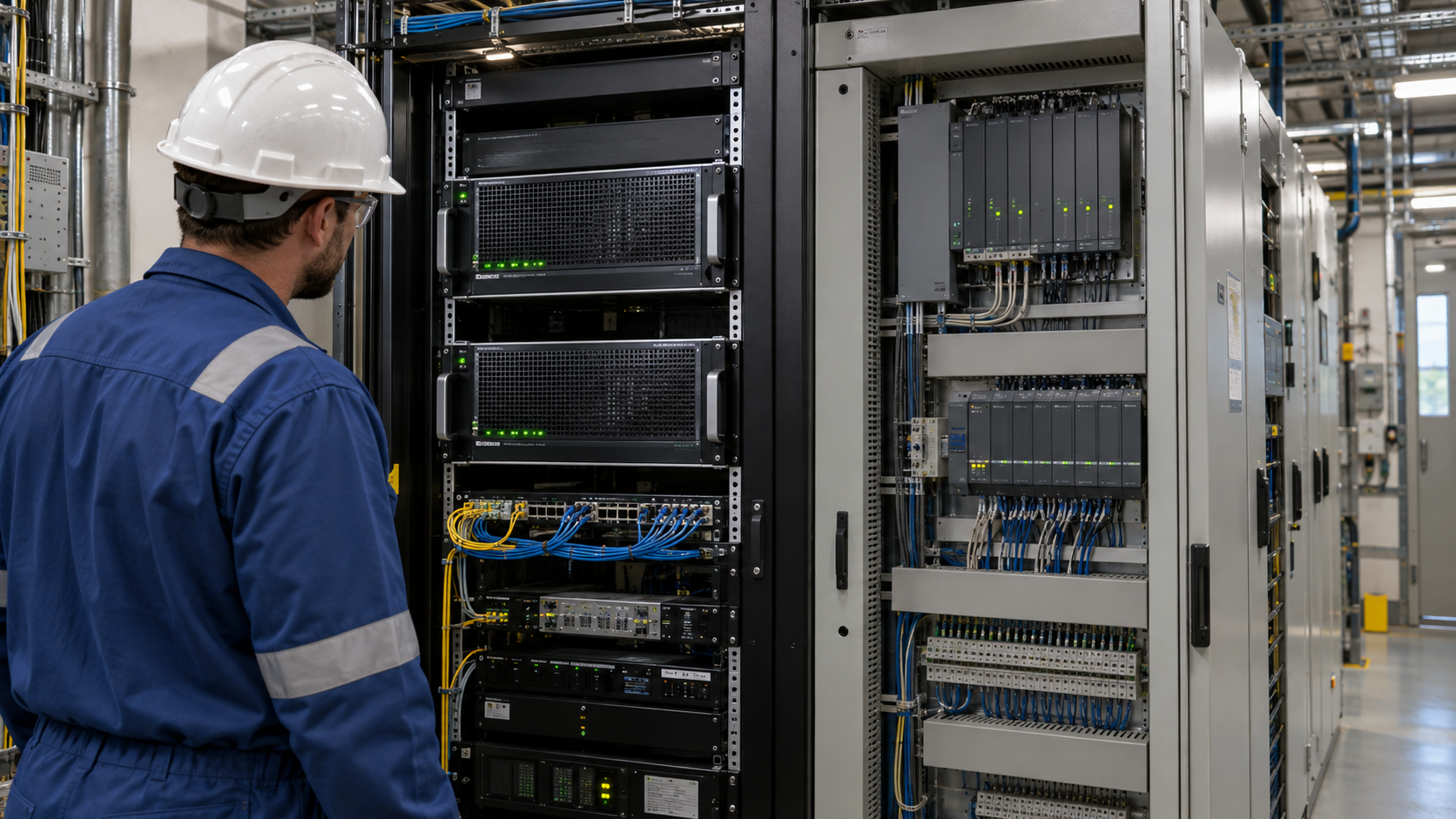
Emerson’s September 22 newsroom announcement introduced the DeltaV IQ Controller as a software-defined control system running in a scalable virtual environment. Emerson’s product information describes multiple controller instances operating on a pair of hosts, 1:1 redundancy across separate hosts, and a phased approach alongside existing physical controllers. The announcement also makes company-reported capacity and AI-readiness claims; those figures should not be treated as a guaranteed outcome for another plant.
For maintenance teams, the important shift is not that physical controllers suddenly disappear. It is that the control function may depend on a broader, validated compute environment. That changes what “keep a spare controller” can mean—and makes it more important to know which installed architecture a maintenance request is actually supporting.
One control function, more than one support boundary
In a traditional arrangement, teams may identify a controller by its catalog number, revision and installed I/O or communications modules. With server-based control, the support boundary can also include the approved host model and options, software release, virtualization configuration, licensing, redundancy arrangement and the mapping of control instances to hosts. These are general planning implications of the architecture—not a published DeltaV IQ bill of materials. Confirm the actual supported configuration against the site’s vendor documentation.
Keep legacy and software-defined assets distinct
Emerson says the IQ Controller is designed to augment purpose-built controllers and that sites can deploy it alongside existing physical controllers as a phased adoption. During such a transition, the asset register should distinguish which loops or areas run on which architecture. A site-level label such as “DeltaV controller spare” may be too broad if it does not identify whether the request concerns a physical controller, an I/O component, a host or another supported part of the system.
When planning support, record the exact installed part or host identifiers, model and option codes, software version, relevant redundancy configuration, affected control area, and any approved restoration or failover procedure. Preserve configuration backups and change records under the plant’s own access and change-control rules. Do not assume a general-purpose server, a visually similar controller or a different software release is interchangeable without an engineering-approved compatibility check.
A practical maintenance question
If a control instance is unavailable, first use the approved system diagnostics to determine whether the issue is with a physical controller or I/O component, host availability, software state, network connectivity or the configured redundancy path. Capture the alarm, timestamp and affected area before requesting a part. This is a diagnostic framing aid, not a substitute for the site’s DeltaV procedures or qualified controls engineering review.
NANKMOS can review industrial automation spare-part identification details. Availability, condition, compatibility and lead time are confirmed for each enquiry; this article does not imply Emerson authorization, product stock or a service relationship. Browse our product catalogue, brand information and maintenance resources, or send an enquiry with the available system records.
Sources and image note
Emerson, DeltaV IQ Controller announcement listed in the company newsroom on September 22, 2026; see also Emerson’s DeltaV IQ Controller product information for the published server-based, multiple-instance and redundancy details.
Related guides
View all guides
Siemens and P&G Expand AI Inspection: What Keeps the Line Running
Siemens’ recent AI inspection announcement highlights an interconnected camera, edge-computing and PLC workflow. Here is how maintenance teams can trace faults before replacing hardware.
Read guide
Emerson’s Planned Qatar Service Center: What Flow-Instrument RFQs Still Need
Emerson has announced a planned Qatar automation service center. Here is what buyers should document in flow-instrument RFQs while its capabilities remain future plans.
Read guide
ABB Infinitus and Data-Center DC Power: RFQ Records for Automation Spares
A practical RFQ framework for documenting power, automation, cooling and protection interfaces as data-center power architectures evolve toward DC and hybrid designs.
Read guide
Schneider SCADAPack x70 Advisory: RFQ Records for Remote RTU Spares
How maintenance teams can preserve hardware, firmware, communication and security context when preparing an RFQ for Schneider SCADAPack x70 remote RTU spares.
Read guideSend your part number, photos or nameplate.
Our team will verify, check availability, and reply with options within 24 hours.
[email protected]+86 18359268345WhatsApp