
Industry Applications
Electrified Process Heating: Where Power Control Meets the Process Loop
A practical way to distinguish process measurement, control logic and electrical power boundaries when an industrial process heater shows a temperature deviation.
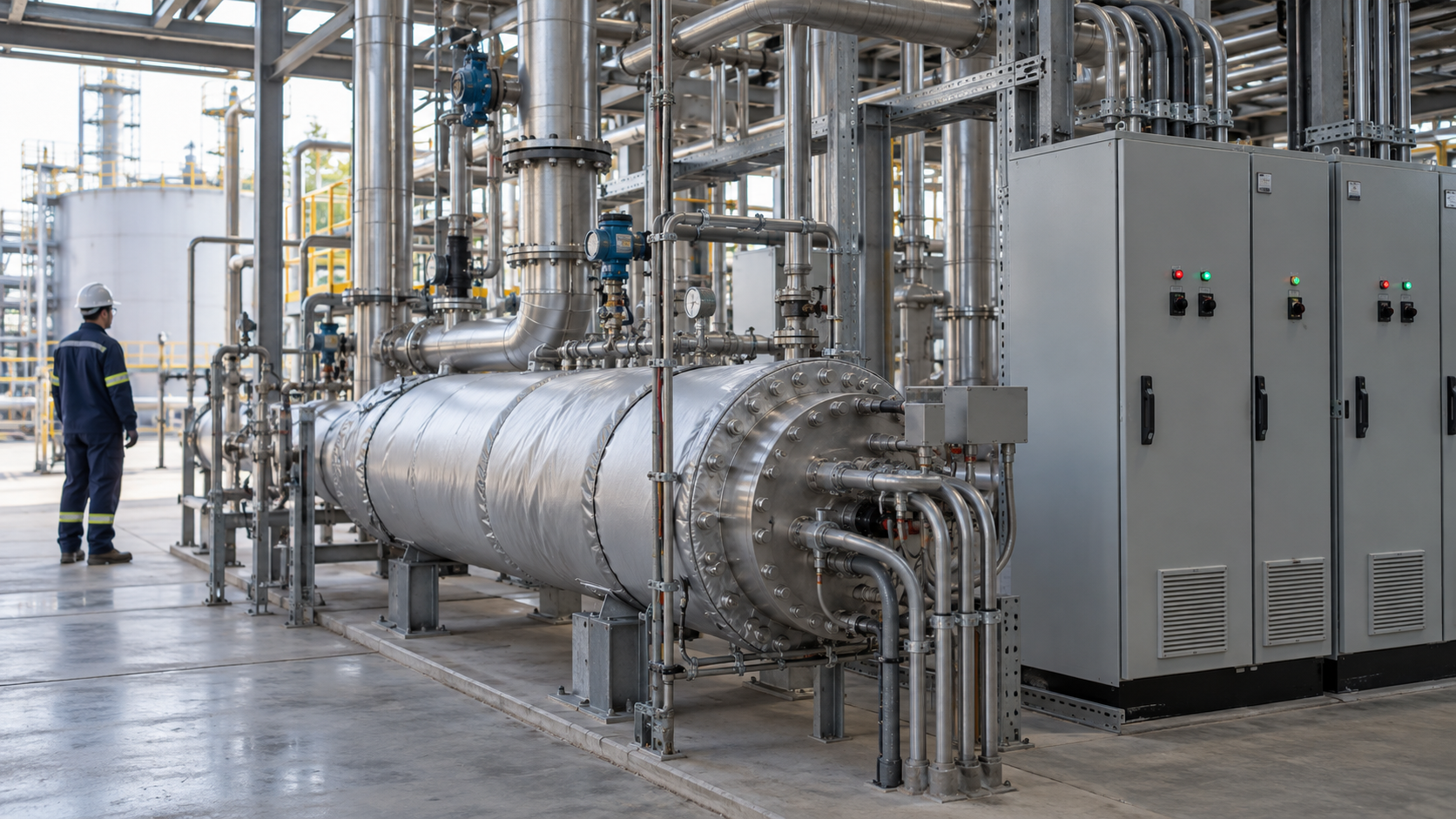
When a process heater is electrified, a temperature problem is not automatically a temperature-controller problem. The observed process value sits at the end of a chain that can include the heater, power conversion and distribution, control signals, instrumentation, and the process itself. A useful first response is to locate which boundary has changed before treating any one component as the cause.
Recent project context: Schneider Electric reported on 23 September 2026 the successful installation of an industrial-scale electric heater at Shell’s Energy and Chemicals Park Rheinland with Axens. Axens’ project release describes a modular electrical package with switchgear, transformers, and a power-control system interfacing with the process-control system. The announcement is a project example, not a universal design specification; the installed configuration and maintenance responsibilities remain site-specific.
One temperature symptom, several different boundaries
If process temperature drifts, the control-room trend alone cannot tell you whether the process is receiving the requested heat. Compare the setpoint and measured process value with the controller output, the power controller’s status or demand, and the electrical measurements available under the site’s approved procedures. Then compare the response with the operating state and the relevant alarm sequence.
- Measurement boundary: a sensor, transmitter, input channel, range, or wiring issue can make the reported temperature misleading even when the heating system is responding normally.
- Control boundary: the controller may be limiting or withholding demand because of an interlock, permissive, configured limit, or control-mode change. Check the approved logic and event history; do not bypass protection to test a theory.
- Power boundary: a power controller, switchgear path, transformer, supply condition, or heater circuit may not be delivering the commanded output. Electrical checks belong to qualified personnel using the site’s isolation and safety procedures.
These are diagnostic boundaries, not a do-it-yourself troubleshooting sequence. In a high-energy process installation, a maintenance team should follow the current cause-and-effect documents, electrical drawings, equipment manuals, and site authorization process.
Why the interface record matters
Electrified heating can connect electrical equipment and process controls that were previously managed as separate packages. A fault report should therefore preserve both sides of the interface: the process tag and instrument range, the controller or I/O reference, the power-control and feeder identification, relevant alarm text, and the approved drawing or document revision. If a module or assembly is being evaluated for replacement, record its full nameplate and configuration details rather than inferring interchangeability from a family name.
For a supplier enquiry, include the exact manufacturer and part number, installed location, nameplate photographs where permitted, associated assembly or drawing reference, and the symptom or alarm context. State whether the request concerns an instrument, control-system component, power-control device, or a complete electrical package. Those are materially different scopes; a similar-looking module is not evidence that it is compatible with a particular heater or plant interface.
Keep project news separate from plant-specific advice
The Shell Rheinland announcement demonstrates a power-and-process interface in one reported project. It does not establish that every electric heater uses the same topology, controller, communications method, or spares strategy. The technical reference linked below from OMRON describes general heater power-controller behavior, including control signals and modulation methods; it should not be treated as the design basis for a different vendor’s installed system.
NANKMOS does not claim to supply the Shell/Axens/Schneider project package. For industrial automation spare enquiries, browse our product catalogue and brand directory. To discuss a specific installed part, use the contact page and provide the identifiers and application context your site permits you to share. Additional technical articles are available in Resources.
This article is general information, not an operating procedure or engineering approval. Site drawings, equipment documentation, electrical safety rules, and the responsible plant authority govern all inspection, isolation, repair, and replacement decisions.
Related guides
View all guides
DeltaV IQ Controller: How Server-Based Control Changes Spare Planning
Emerson’s DeltaV IQ announcement highlights server-based control. Here is how maintenance teams can distinguish host, software, redundancy and physical-controller support boundaries.
Read guide
Siemens and P&G Expand AI Inspection: What Keeps the Line Running
Siemens’ recent AI inspection announcement highlights an interconnected camera, edge-computing and PLC workflow. Here is how maintenance teams can trace faults before replacing hardware.
Read guide
Emerson’s Planned Qatar Service Center: What Flow-Instrument RFQs Still Need
Emerson has announced a planned Qatar automation service center. Here is what buyers should document in flow-instrument RFQs while its capabilities remain future plans.
Read guide
ABB Infinitus and Data-Center DC Power: RFQ Records for Automation Spares
A practical RFQ framework for documenting power, automation, cooling and protection interfaces as data-center power architectures evolve toward DC and hybrid designs.
Read guideSend your part number, photos or nameplate.
Our team will verify, check availability, and reply with options within 24 hours.
[email protected]+86 18359268345WhatsApp