
Maintenance & RFQ Guides
Honeywell Warehouse Automation RFQ: Pallet, AMR and Sortation Checks
Honeywell has recently outlined a collaborative warehouse automation approach that combines palletizing, autonomous mobile robots, sortation and software orchestration. For a buyer, the important question is not whether one device looks suitable. The RFQ must define how the pallet, robot, conveyor, sorter, safety system and warehouse software work together. This guide converts Honeywell’s public Manufacturing […]
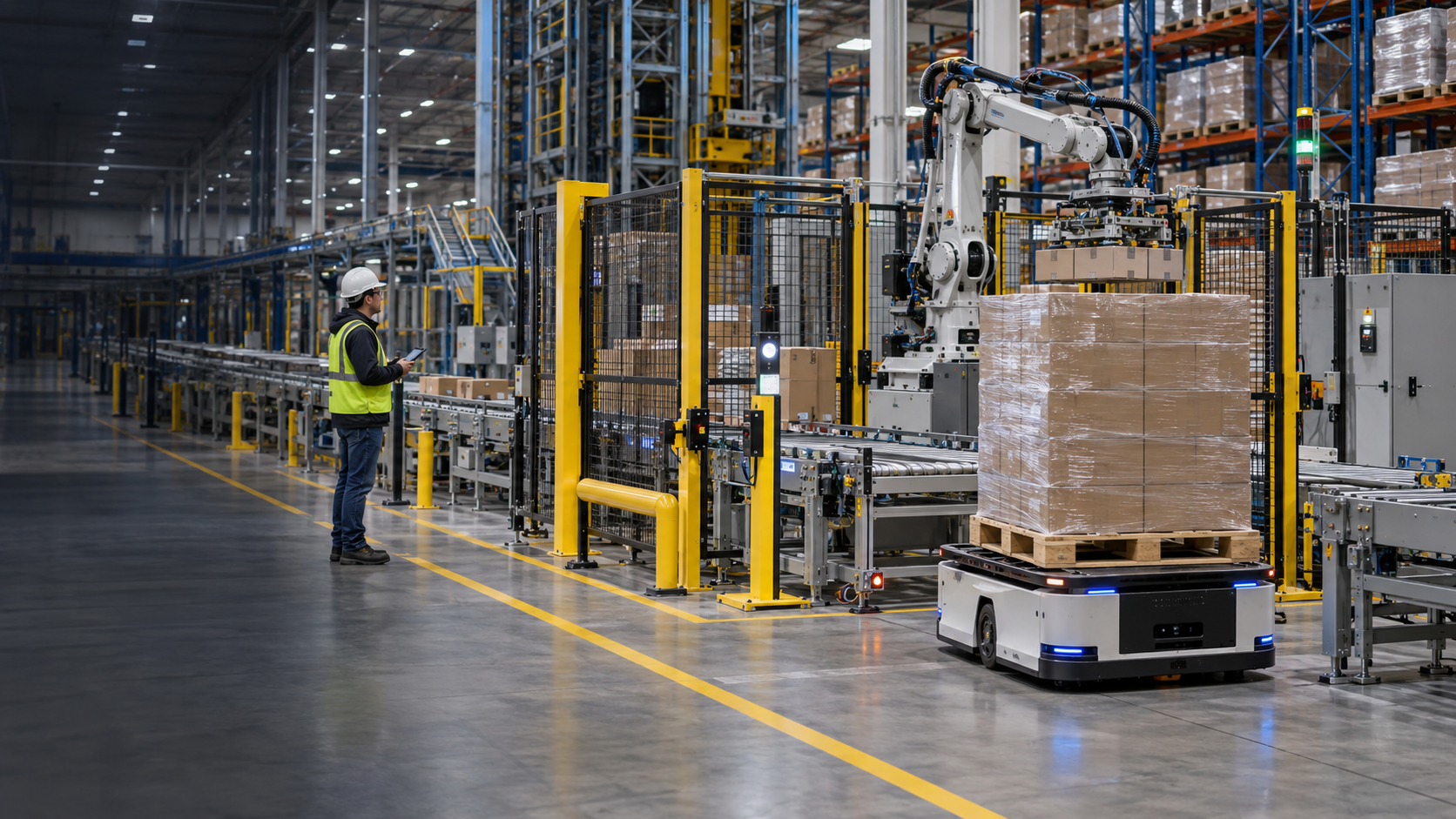
Honeywell has recently outlined a collaborative warehouse automation approach that combines palletizing, autonomous mobile robots, sortation and software orchestration. For a buyer, the important question is not whether one device looks suitable. The RFQ must define how the pallet, robot, conveyor, sorter, safety system and warehouse software work together.
This guide converts Honeywell’s public Manufacturing Day and Pack Expo discussion into a practical inquiry checklist. It does not confirm stock, delivery, system compatibility or project performance. Those points require a configuration review against the actual facility, load profile and control architecture.
What the Honeywell update highlights
Honeywell describes a connected warehouse approach built around pallet integrity, automated palletizing, autonomous mobile robots, sortation and system orchestration. The article refers to Alvey palletizing and depalletizing systems, autonomous mobile robots, the IntelliSort Irregulars Sorter and Momentum software. These references are useful for understanding the system boundary, but they do not define a universal package for every site.
Read the original Honeywell collaborative automation article and request the current technical documentation for the exact equipment and software version under review.
1. Start with the unit load and pallet condition
Warehouse automation often fails at the handoff between physical load and control logic. Describe the pallet type, dimensions, weight range, center of gravity, overhang limits, wrapping method and expected variation. Include the percentage of mixed-SKU pallets, damaged pallets, unstable cartons and non-conveyable packages.
- Pallet material, dimensions and allowable load
- Carton size, weight, height and overhang range
- Stretch-wrap, banding or other load-stabilization method
- Barcode or identifier location and readability
- Rejected-load handling and manual recovery process
A proposal that only lists a palletizer or AMR without the load envelope leaves a major compatibility question unanswered.
2. Define the AMR route and handoff points
For an autonomous mobile robot inquiry, provide the route map, floor conditions, aisle widths, turning areas, traffic rules, lift heights and pickup or drop-off coordinates. Identify where the AMR receives a mission, confirms the load and hands the pallet to a conveyor, storage system or operator.
Ask which sensors, markers, maps, fleet-management functions and safety devices are included. Clarify whether the robot is expected to interface with an existing warehouse execution system, manufacturing execution system or line-control layer. A route that works in a clear test area may need different controls when pedestrian traffic, temporary obstacles and production changeovers are included.
3. Separate conveyor and sortation responsibilities
Document every physical transfer: palletizer to conveyor, conveyor to AMR, AMR to storage, sorter to outbound lane and any manual exception station. For cartons or irregular packages, state the dimensions, materials, flexibility, barcode position and acceptable orientation.
Ask the supplier to identify the mechanical and control responsibilities at each handoff. Include conveyor speed, accumulation logic, sensor locations, jam detection, reject routing and restart behavior. This is especially important when an irregulars sorter is being considered alongside existing conveyors or third-party equipment.
4. Confirm the safety boundary
Request a site-specific safety concept rather than a general statement that the equipment is safe. Map fencing, gates, light curtains, scanners, emergency stops, safe-speed functions, pedestrian crossings and recovery zones. Clarify how a technician clears a jam, resets a safety circuit and returns equipment to automatic operation.
Include the applicable country and site standards in the RFQ. Also ask which safety components are supplied, which are integrated by the system builder and which must be approved by the end user. The boundary should cover the palletizer, conveyor, AMR routes and manual work areas together.
5. Detail software and controls integration
List the existing PLC, warehouse execution system, fleet manager, network architecture and required data exchanges. Ask for supported protocols, message formats, event acknowledgements, alarm handling, user roles, audit trails and version dependencies. Avoid assuming that a software name alone defines the interface.
For a retrofit, attach the current I/O list, network diagram, software version, alarm list and representative mission or order messages. State whether the project requires new orchestration, a gateway or only a documented interface to an existing controller.
6. Request maintenance and spare-part information
Request the recommended preventive-maintenance schedule, wear parts, sensor list, robot battery or charging requirements, conveyor drive components, palletizer tooling, sorter modules and software support dependencies. Ask which identifiers are needed to quote a replacement and whether firmware or parameter backups are part of the service package.
For an installed Honeywell or Intelligrated system, include equipment nameplates, cabinet labels, controller and drive references, robot model, software release and recent fault history. Separate confirmed identifiers from assumptions so a possible substitute is not treated as an approved equivalent.
Related NANKMOS resources
See the Honeywell brand page and the industrial automation product catalog. The Honeywell RFQ boundary article provides a related control-system perspective, while Resources and the NANKMOS contact page are available for parts lists, identifiers and inquiry details.
Conclusion
A warehouse automation RFQ should describe the complete material flow, not just one robot, sorter or palletizer. Pallet condition, AMR routing, conveyor handoffs, safety zones, control interfaces and maintenance evidence determine whether a proposed package can be evaluated properly. NANKMOS can help organize the identifiers and open technical questions before a supplier review.
Source: Honeywell, “From Manufacturing Day to Pack Expo: The Future of Collaborative Automation,” October 2026. System scope, compatibility, availability and project suitability must be confirmed against current manufacturer documentation.
Related guides
View all guides
Machine Vision False Rejects: Check the Lighting Before the Camera
When a reflective part fails inspection, compare reference images before ordering a camera. Learn when to scope the light, controller or mounting instead.
Read guide
AMR Charging Faults: Is the Spare on the Robot or at the Dock?
When an AMR stops charging, distinguish the fixed dock from the vehicle battery. Use dock IDs and fleet events to scope the right replacement RFQ.
Read guide
Servo Drive Spares: EtherCAT Is Not the Encoder Interface
An EtherCAT drive can still be the wrong spare. Learn how to verify the motor encoder protocol, feedback cable and exact drive variant before ordering.
Read guide
CENTUM R7.02: An Estimate Is Not a Field Measurement
Yokogawa’s CENTUM R7.02 adds AI Estimation. See how to distinguish model outputs, transmitter readings and laboratory results before ordering a spare.
Read guideSend your part number, photos or nameplate.
Our team will verify, check availability, and reply with options within 24 hours.
[email protected]+86 18359268345WhatsApp