
Product Systems
ABB Fashion Inductor: Keeping Repairs Repeatable
ABB Fashion Inductor maintenance: preserve camera, gripper, controller and vision-model records so a replacement can be assessed against the cell baseline.

ABB’s 15 October 2026 Fashion Inductor announcement connects a familiar maintenance question with a changing software lifecycle: what exactly must be restored after a component is replaced?
ABB describes an upgraded apparel-induction module that combines AI Robot Trainer, application-specific vision and a digital twin. Its stated workflow can retrain models as products and operating conditions change. For a maintenance team, that makes the last accepted configuration worth preserving alongside the physical parts list.
The same replacement part can return to a different cell
Consider an illustrative repair, not a reported ABB customer incident. A camera or gripper is replaced on a cell handling garments in flexible packaging. The replacement has the intended identifier, but the team cannot confirm which camera settings, tool configuration or model release were accepted before the interruption.
There are now two separate questions: whether the hardware is suitable and whether the cell has been restored to an approved operating state. A successful part-number match answers only the first question. Even then, the installed revision and application requirements still need review.
The useful baseline is a dated record of what the cell was running when its performance was accepted. It should connect the physical assembly to the relevant software and configuration records, rather than leaving those records in unrelated folders or service notes.
Connect the model record to the physical installation
Record the actual camera, optics and lighting arrangement where applicable, including their installed positions and the approved settings. Record the end effector, its mounting and the relevant tool configuration. Keep controller and application versions with those identifiers so an engineer can review the complete state rather than a photograph of one component.
Where the installed solution uses trained vision models, retain the deployed model identifier and the date it was accepted. Distinguish that deployed version from a model currently being evaluated. This is a recordkeeping principle, not a claim about a particular ABB file format, automatic backup function or required service procedure.
A replacement quotation should state whether it covers hardware alone or also the configuration and validation work. Otherwise, purchasing may receive a suitable assembly while the recovery work remains undefined.
Retraining and repair acceptance have different purposes
ABB’s official release describes a lifecycle workflow that monitors performance, identifies anomalies and feeds model improvements back into the application. That capability should not be read as permission to change the operating baseline during every repair.
For a planned optimization, the team may intentionally evaluate a new product mix or a new model. For a maintenance recovery, the immediate objective may be to restore the last accepted state. Make that objective clear before deciding whether retraining belongs in the work scope.
Keep the repair acceptance record distinct from any subsequent optimization result. The site’s responsible engineer or integrator should define the representative test items and operating checks. This article does not specify a commissioning procedure or authorize changes to robot motion or safety functions.
Record the operating context behind a performance result
A single successful pick is limited evidence. The acceptance record should identify the actual garment and packaging mix used, the tested configuration and the agreed criteria. A comparison made under different lighting, packaging or software conditions may not demonstrate restoration of the same baseline.
ABB’s product descriptions and headline performance targets concern its stated application scope. They are not a guaranteed result for a differently configured cell or a promise made by NANKMOS. Use the installed system documentation and the responsible integrator’s acceptance requirements for the specific application.
Turn the baseline into a useful spare-parts inquiry
When requesting a replacement, send the complete installed identifier, revision, label photographs, quantity and cell location. Explain which baseline must be retained and whether configuration support is included in the request. Keep availability and compatibility confirmation tied to the proposed item.
Use the NANKMOS RFQ contact page for identifiable automation components, and the product catalog and technical resources for identification context. This article does not establish that NANKMOS supplies the complete Fashion Inductor module or every component used within it.
Official references
ABB: ABB Robotics brings industrial-grade physical AI to fashion logistics, 15 October 2026. See also ABB’s Fashion Inductor product overview, accessed 19 October 2026. The maintenance discussion above is NANKMOS’ interpretation of the recordkeeping implications, not an ABB replacement approval.
Featured image: AI-generated illustration of a generic apparel-induction robot cell. It is not a photograph of the ABB Fashion Inductor product or a named customer installation.
Related guides
View all guides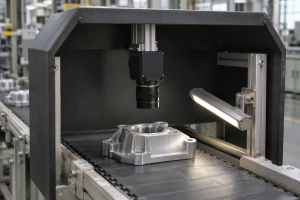
Machine Vision False Rejects: Check the Lighting Before the Camera
When a reflective part fails inspection, compare reference images before ordering a camera. Learn when to scope the light, controller or mounting instead.
Read guide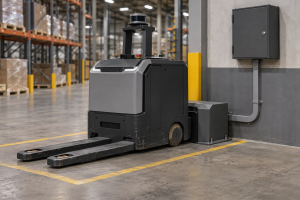
AMR Charging Faults: Is the Spare on the Robot or at the Dock?
When an AMR stops charging, distinguish the fixed dock from the vehicle battery. Use dock IDs and fleet events to scope the right replacement RFQ.
Read guide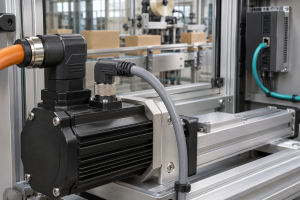
Servo Drive Spares: EtherCAT Is Not the Encoder Interface
An EtherCAT drive can still be the wrong spare. Learn how to verify the motor encoder protocol, feedback cable and exact drive variant before ordering.
Read guide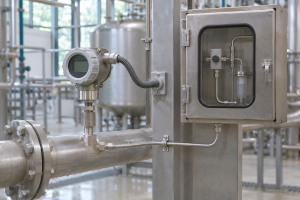
CENTUM R7.02: An Estimate Is Not a Field Measurement
Yokogawa’s CENTUM R7.02 adds AI Estimation. See how to distinguish model outputs, transmitter readings and laboratory results before ordering a spare.
Read guideSend your part number, photos or nameplate.
Our team will verify, check availability, and reply with options within 24 hours.
[email protected]+86 18359268345WhatsApp