
Product Systems
Yokogawa GD80: Why Five Seconds Is Not the Whole Loop
Yokogawa GD80 response time: separate the stated instrument test from sample transport, communication updates and DCS display when reviewing a replacement.
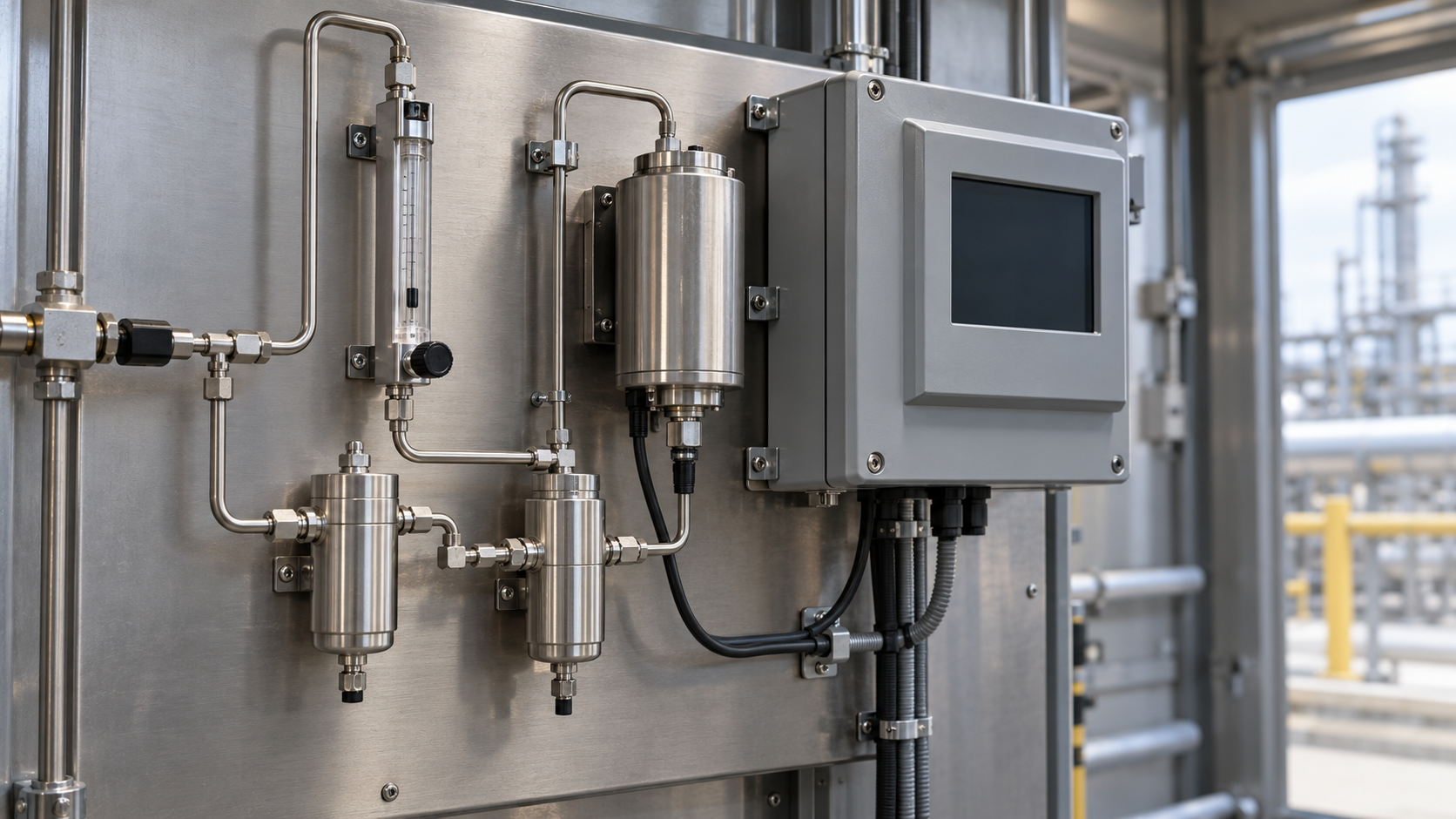
Gas density meter response time is meaningful only when the start point, end point and test conditions are clear. A headline figure for an instrument should not be treated as the guaranteed delay between a change in the process and an updated value on a DCS screen.
Yokogawa’s October 16, 2026 announcement introduces the GD80 detector and GD802G/GD802S converter lineup. Its five-second claim uses a specific endpoint: the displayed value reaching 90% of its final value after a change in gas conditions, at a gas flow rate of 0.6 L/min.
Read the response definition, not just the number
A 90% endpoint is not full settling. More importantly, an instrument test does not establish the response of every installed sampling arrangement.
Keep the definition and its conditions attached to the number when comparing instruments. If another specification uses a different response endpoint or different conditions, identical-looking times do not necessarily describe identical performance.
This matters during replacement planning because an instrument specification can answer one question while the maintenance team is asking another. “How quickly does the instrument display respond?” and “How quickly will the operator see a representative process change?” are related questions, but they are not interchangeable.
Follow the sample, then follow the value
For a sampled installation, review the approved path from the process take-off to the measuring equipment. Sample transport and conditioning belong to that path; they should not disappear from the assessment simply because the new instrument has a faster published response.
The next boundary is the movement of information. Identify which value the converter supplies, how the receiving system obtains it and where any configured filtering or display processing occurs. These are installation-specific questions to resolve from the applicable documentation and controlled configuration, not assumptions to make from a product photograph.
The release describes Ethernet and RS-485 communication support. Naming an interface does not, on its own, establish the update interval of the value used by a particular control application. Nor does it prove that an existing host configuration can be reused unchanged.
Do not simply add unrelated timing specifications together: their definitions may begin at different points or cover overlapping behavior. Ask the responsible instrumentation and controls team to define the end-to-end requirement and how it will be assessed.
Agree what is being compared at handover
An illustrative handover problem is a local converter display and a DCS tag that appear to disagree. Before attributing the difference to defective hardware, the authorized team needs to establish whether both observations represent the same selected quantity, units, range and point in the measurement chain.
Preserve those definitions alongside the installed detector and converter references. Where relevant, include the approved communication configuration and signal-processing settings. A screenshot with a number but no tag identity or units is weak evidence for comparing performance.
Any test must follow site procedures and the manufacturer’s applicable instructions. This article does not provide gas-handling, calibration, purge or alarm-setting instructions. Do not change sample flow, bypass protection or alter control settings merely to reproduce a headline response figure.
Keep performance and installation approval separate
The same release distinguishes availability by version: the release scheduled non-explosion-proof sales from October 16 and IECEx/ATEX explosion-proof versions for the end of April 2027. That future plan must not be described as present approval or availability for a specific hazardous-area installation.
When reviewing the NANKMOS product catalogue, identify the actual detector or converter required and retain the complete installed reference. Through the contact and RFQ page, explain whether the request concerns a like-for-like replacement, a revised measurement requirement or an engineered upgrade. Do not send confidential configurations with an ordinary inquiry.
Availability, offered condition and supporting documentation are confirmed during quotation. Technical suitability and installation approval require the responsible review; neither follows from a catalogue listing. More maintenance reading is available in our resources library.
Source checked October 23, 2026. Product facts and the planned launch date above are attributed to Yokogawa’s October 16 release. Measurement-chain considerations are NANKMOS editorial guidance, not a validated response-time calculation or commissioning procedure. Featured image: AI-generated generic gas-analysis sampling panel, not a Yokogawa product photograph or evidence of explosion-protection certification.
Related guides
View all guides
Machine Vision False Rejects: Check the Lighting Before the Camera
When a reflective part fails inspection, compare reference images before ordering a camera. Learn when to scope the light, controller or mounting instead.
Read guide
AMR Charging Faults: Is the Spare on the Robot or at the Dock?
When an AMR stops charging, distinguish the fixed dock from the vehicle battery. Use dock IDs and fleet events to scope the right replacement RFQ.
Read guide
Servo Drive Spares: EtherCAT Is Not the Encoder Interface
An EtherCAT drive can still be the wrong spare. Learn how to verify the motor encoder protocol, feedback cable and exact drive variant before ordering.
Read guide
CENTUM R7.02: An Estimate Is Not a Field Measurement
Yokogawa’s CENTUM R7.02 adds AI Estimation. See how to distinguish model outputs, transmitter readings and laboratory results before ordering a spare.
Read guideSend your part number, photos or nameplate.
Our team will verify, check availability, and reply with options within 24 hours.
[email protected]+86 18359268345WhatsApp