
Product Systems
Cabinet Cooling: Compare the Right Airflow Rating
Bare-fan airflow and installed filter-fan performance are different. Compare the documented fan-and-exhaust-filter combination before approving a replacement.
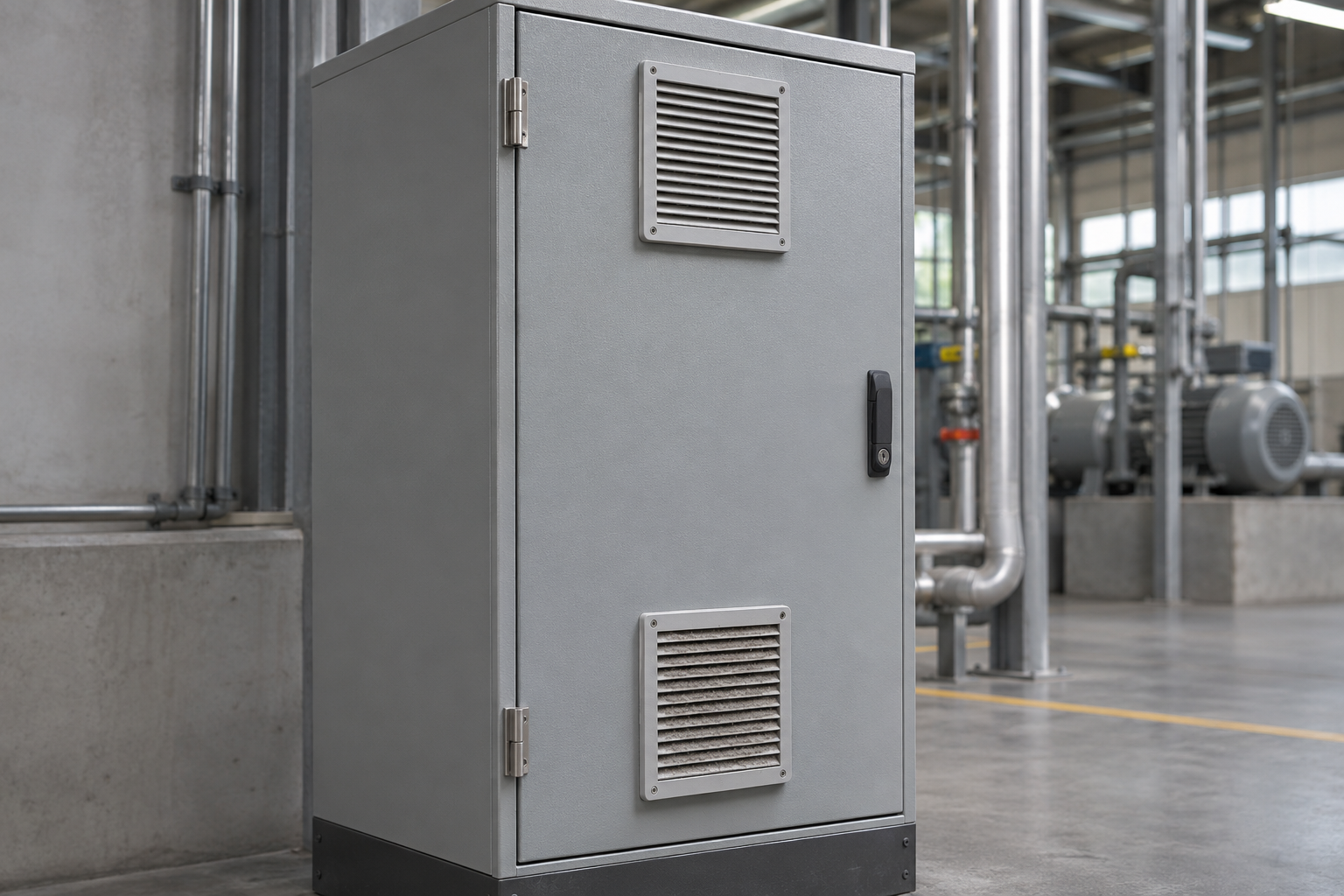
Enclosure cooling is on the SPS agenda again. November 13 industry coverage highlights planned Pfannenberg thermal-management previews, while the manufacturer’s own announcement confirms that new cooling developments and next-generation filter fans will be previewed at SPS in Nuremberg on November 24–26, 2026. A preview is not a confirmed replacement specification or evidence of supplier stock.
While new equipment is being discussed, an existing maintenance question remains useful: when two fan quotations show different airflow figures, are they measuring the same thing?
Three figures can describe different boundaries
Pfannenberg’s technical explanation of filter-fan airflow distinguishes a bare fan’s free-air rating from the free-blowing figure for a complete fan, housing and filter assembly. It then identifies the combination of filter fan and exhaust filter as the relevant configuration for enclosure cooling. This is an established technical reference, not a newly announced product capability.
The distinction matters because the outlet filter also resists the airflow. The assembled system’s performance depends on that resistance, not simply on the largest number printed beside the fan component. The manufacturer points to the complete unit’s pressure/airflow data for a more meaningful assessment.
A quotation comparison can fail before a part is ordered
Consider a hypothetical purchasing comparison. Offer A gives a bare-fan figure, while Offer B gives a figure for a fan-and-exhaust-filter combination. Selecting A only because its headline number is larger does not establish that it will cool the intended enclosure better. First align the measurement boundary and the documented configuration.
That is a comparison problem rather than proof that either offer is unsuitable. Ask the supplier which assembly the figure describes and which supporting document applies. Keep that explanation with the quotation so the engineering reviewer is not reconstructing the basis of the comparison later.
Do not turn an airflow claim into a fault diagnosis
A hot control cabinet does not, by itself, identify a failed PLC, power supply or fan. Equally, an available fan with a familiar appearance is not automatically an approved replacement for the installed arrangement. The maintenance investigation and the commercial part search should remain separate decisions.
The responsible engineer should review the actual installation against its documentation and approved maintenance process. This article is not an instruction to remove filters, enlarge openings, alter airflow arrangements or inspect live cabinet internals. Protection requirements must not be bypassed to obtain a higher airflow number.
Keep the thermal question attached to the enquiry
For an identified automation part, preserve the complete installed reference and clarify whether the request concerns a component, an assembled unit or an accessory. If a thermal concern prompted the enquiry, retain that context without presenting an unverified diagnosis as an established fault.
Our product-system resources and industrial automation catalogue provide starting points for identification. Use NANKMOS Contact / RFQ to request confirmation for the specific part and quantity. Availability, condition, lead time and any proposed alternative require individual confirmation; neither an exhibition preview nor a quoted airflow value establishes those commercial details.
Related guides
View all guides
Machine Vision False Rejects: Check the Lighting Before the Camera
When a reflective part fails inspection, compare reference images before ordering a camera. Learn when to scope the light, controller or mounting instead.
Read guide
AMR Charging Faults: Is the Spare on the Robot or at the Dock?
When an AMR stops charging, distinguish the fixed dock from the vehicle battery. Use dock IDs and fleet events to scope the right replacement RFQ.
Read guide
Servo Drive Spares: EtherCAT Is Not the Encoder Interface
An EtherCAT drive can still be the wrong spare. Learn how to verify the motor encoder protocol, feedback cable and exact drive variant before ordering.
Read guide
CENTUM R7.02: An Estimate Is Not a Field Measurement
Yokogawa’s CENTUM R7.02 adds AI Estimation. See how to distinguish model outputs, transmitter readings and laboratory results before ordering a spare.
Read guideSend your part number, photos or nameplate.
Our team will verify, check availability, and reply with options within 24 hours.
[email protected]+86 18359268345WhatsApp