
Product Systems
Why CT and VT Records Belong on Separate Lines
Keep CT and VT instrument-transformer records distinct: preserve function, exact nameplate identity and drawing context before a spare-parts inquiry.
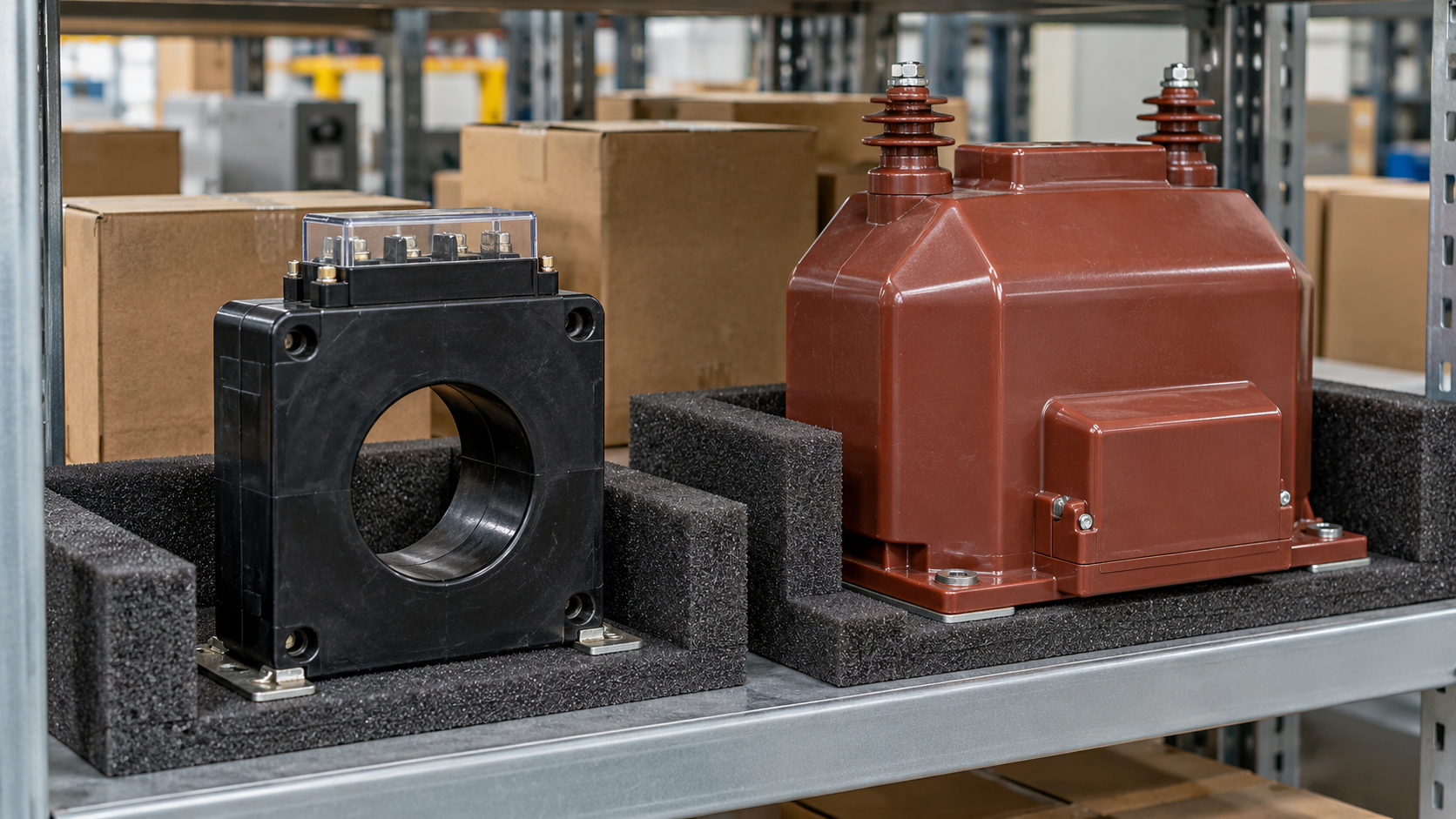
Two items on a maintenance list may both be called “transformer” while serving different purposes. One belongs to a current-measurement circuit; another belongs to a voltage-measurement circuit. If that distinction disappears during a handover, a clear-looking parts list can still describe the wrong requirement.
For industrial maintenance and sourcing teams, the first task is to preserve the function already established by the plant’s records—not to select a replacement from its shape or brand alone.
Start with the function, then retain the exact identity
CT means current transformer; VT means voltage transformer. GE Vernova’s instrument-transformer overview lists current and voltage transformer families separately. It also distinguishes combined metering units, control power transformers, and test and control switches. A broad catalogue heading therefore does not make the items beneath it interchangeable.
That manufacturer page is an existing product reference, not a new November launch. Use the classification to locate the appropriate documentation, then keep the installed manufacturer’s full model, suffixes and nameplate information intact. “CT” or “VT” narrows the question; neither abbreviation completes a part identification.
Why a current brand announcement cannot rewrite the installed record
On 28 October 2026, GE Vernova announced an agreement to acquire Trench Group, whose products include instrument transformers, bushings and coils. The release states that closing is expected in late 2027, subject to approvals and other stated requirements. This is a signed transaction agreement, not a completed acquisition.
The maintenance implication is straightforward: retain the original identity of installed equipment. A corporate development does not establish a new replacement code, an unchanged support route or a cross-brand substitute for a particular unit. Those questions require separate confirmation from the relevant documentation and responsible engineering team.
Make the list readable without inventing missing specifications
Consider a hypothetical parts list with two entries: “transformer, cabinet A” and “transformer, cabinet B.” Adding the photograph filenames helps, but the reader still has to infer which function each item serves. A better record keeps the plant’s CT or VT classification, equipment tag, exact reference and associated drawing reference on the corresponding line.
Where ratings or other nameplate entries are unclear, preserve a legible image or transcribe the visible text with the uncertainty marked. Do not fill a missing field from a visually similar online product. In particular, a ratio recorded without its units and context can lose the meaning it had on the original label.
Keep the function assigned by site engineering alongside the identity. For example, if plant documents specify a particular metering or protection duty, do not shorten that to a generic “measurement spare” during purchasing. Record the approved duty as documented; this blog does not assign a rating, accuracy requirement or application class to any device.
If the equipment tag, drawing and nameplate disagree, flag the disagreement for engineering review. An incomplete but honest entry is more useful than a complete-looking record assembled from assumptions.
Keep the component and the wider control system connected
The transformer is one identified item, not a diagnosis of every meter, relay, communication interface or control module associated with it. Retain the approved drawing reference so the plant team can see which equipment the inquiry concerns. Our overview of DCS spares for power and chemical plants offers broader control-system sourcing context.
Do not disconnect, bridge, open or test instrument-transformer circuits using this article as guidance. Qualified personnel must follow the exact manufacturer’s instructions, applicable safety requirements and the site’s authorized maintenance procedures.
When reviewing automation spare parts, submit each identified requirement separately through the NANKMOS contact form. Availability, offered condition and suitability need unit-specific RFQ confirmation. A brand name or matching outline is not a replacement approval.
Related guides
View all guides
Machine Vision False Rejects: Check the Lighting Before the Camera
When a reflective part fails inspection, compare reference images before ordering a camera. Learn when to scope the light, controller or mounting instead.
Read guide
AMR Charging Faults: Is the Spare on the Robot or at the Dock?
When an AMR stops charging, distinguish the fixed dock from the vehicle battery. Use dock IDs and fleet events to scope the right replacement RFQ.
Read guide
Servo Drive Spares: EtherCAT Is Not the Encoder Interface
An EtherCAT drive can still be the wrong spare. Learn how to verify the motor encoder protocol, feedback cable and exact drive variant before ordering.
Read guide
CENTUM R7.02: An Estimate Is Not a Field Measurement
Yokogawa’s CENTUM R7.02 adds AI Estimation. See how to distinguish model outputs, transmitter readings and laboratory results before ordering a spare.
Read guideSend your part number, photos or nameplate.
Our team will verify, check availability, and reply with options within 24 hours.
[email protected]+86 18359268345WhatsApp