
Product Systems
Slow-Speed Vibration: Sampling Rate and Record Length
Slow shaft speed does not define every useful vibration frequency. Distinguish sampling rate, record duration and actual module settings before comparing data.
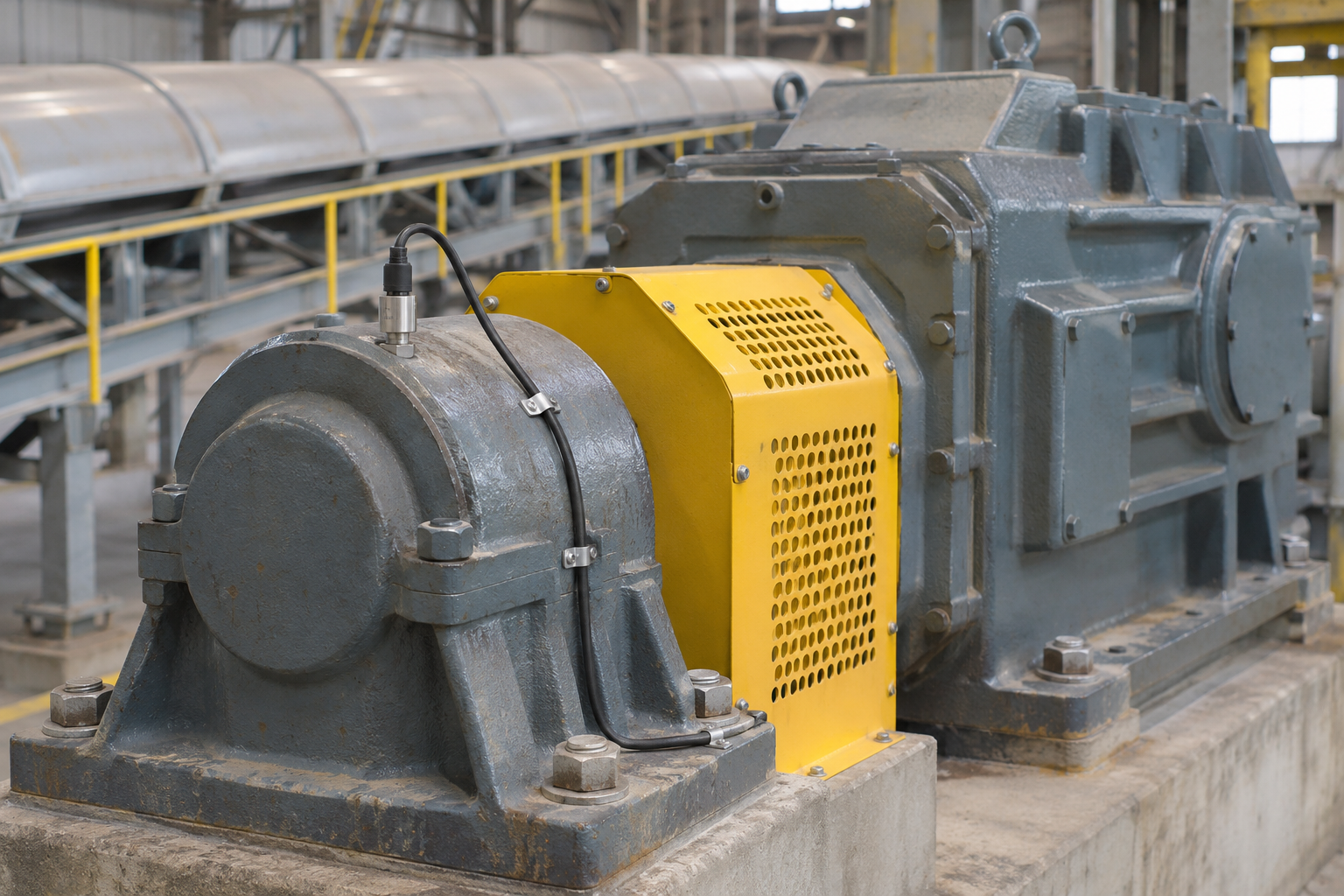
Slow shaft speed can make a vibration record look deceptively simple. Yet a slowly recurring mechanical event can contain much faster signal detail. Understanding that distinction is important when reviewing monitoring data or sourcing a replacement measurement module.
The published programme for Windenergietage (November 10–12, 2026), included BayWa r.e.’s November 11 session on operations management and AI-supported monitoring. That provides recent industry context, not evidence that a particular measurement setup is adequate. The technical discussion below draws on existing manufacturer references rather than an announcement of a new sensor.
Slow repetition and fast detail can coexist
In Bachmann’s “Hidden in Plain Sight” technical article, the manufacturer explains how impacts can excite higher-frequency structural responses even when the underlying equipment rotates slowly. Envelope analysis uses information from that higher-frequency content to help reveal repeating impacts.
The practical distinction is between how often an event repeats and the signal detail within each event. Low running speed alone does not establish the measurement bandwidth needed for the analysis. This is an established technical reference, not a November 2026 product launch.
Sampling rate and duration answer different questions
Sampling rate describes how many samples are acquired per second; duration describes how much time the record covers. Recording for longer does not restore signal detail that the measurement chain did not capture.
There is also a simple arithmetic tradeoff: with a fixed number of samples, doubling the sampling rate halves the recording duration. That is an illustration of the relationship, not a recommended setting. The responsible analyst needs to consider both the required signal detail and the observation period, rather than choosing one headline number.
A module’s maximum rate is not its acquisition record
For a concrete product example, the Bachmann AIC206 product page lists adjustable sampling up to 51.2 kHz. It also describes a timestamped ring buffer that stores rotational speed. These are documented capabilities of that module, not proof that a specific installation captured a particular event at its maximum rate.
When handing a record to an analyst, preserve the actual acquisition configuration alongside the data. A product brochure and a trend screenshot cannot establish what settings were used for that recording. Keep available operating-state information attached as well, so the reviewer can understand the context rather than reconstruct it from a purchase description.
Carry the distinction into a parts enquiry
“Vibration input module” is an application description, not a complete replacement specification. Identify the installed assembly and retain its configuration records separately from the commercial enquiry. A qualified engineering review should determine whether a proposed replacement preserves the required measurement function.
Our Bachmann parts pages and product-system resources can provide an identification starting point. Through NANKMOS Contact / RFQ, send the confirmed part reference, revision details where applicable and quantity. Availability, condition, lead time and alternatives require individual confirmation. This article does not prescribe alarm thresholds, sensor installation work or changes to live machinery-protection settings.
Related guides
View all guides
Machine Vision False Rejects: Check the Lighting Before the Camera
When a reflective part fails inspection, compare reference images before ordering a camera. Learn when to scope the light, controller or mounting instead.
Read guide
AMR Charging Faults: Is the Spare on the Robot or at the Dock?
When an AMR stops charging, distinguish the fixed dock from the vehicle battery. Use dock IDs and fleet events to scope the right replacement RFQ.
Read guide
Servo Drive Spares: EtherCAT Is Not the Encoder Interface
An EtherCAT drive can still be the wrong spare. Learn how to verify the motor encoder protocol, feedback cable and exact drive variant before ordering.
Read guide
CENTUM R7.02: An Estimate Is Not a Field Measurement
Yokogawa’s CENTUM R7.02 adds AI Estimation. See how to distinguish model outputs, transmitter readings and laboratory results before ordering a spare.
Read guideSend your part number, photos or nameplate.
Our team will verify, check availability, and reply with options within 24 hours.
[email protected]+86 18359268345WhatsApp