
Industries & Applications
Wind-Turbine Repowering: Give Spare Records a Cutover Date
Wind-turbine repowering spares need asset-specific records. Track configuration cutover dates, retained legacy stock and removed-part status before ordering.
Wind-turbine repowering spares should be tied to the configuration currently accepted for each machine, not simply to its original model or the date a component was purchased. During a staged upgrade, two turbines at the same site may legitimately need different replacement references.
GE Vernova’s October 20, 2026 article on partial repowering describes retaining selected turbine infrastructure while upgrading rotor and drivetrain equipment. It also discusses the different baseline turbine models involved. This is useful lifecycle context, but it is not a compatibility table for control boards, sensors or other individual spares.
The maintenance implication is a records problem: when does an old parts list stop being the applicable list for a particular asset? A controlled cutover record can make that transition visible without erasing the history needed to support machines that have not yet been upgraded.
One fleet can have two valid baselines
Consider an illustrative site where Turbine A has completed an approved modification while Turbine B is still awaiting work. A stores item previously allocated to both machines should not automatically remain approved for both. Neither should it automatically be declared obsolete for the whole site.
The answer depends on the approved scope of the modification and the references that apply to each asset. Some components may remain unchanged; others may have different requirements. Do not infer either outcome from the fact that repowering has occurred.
Keep the original reference linked to the assets for which it remains applicable. Link the revised reference to the assets covered by the accepted change. Where interchangeability has been formally established, retain the supporting document rather than relying on a verbal assurance or a shared enclosure shape.
Make acceptance the visible transition
A project order date does not prove that a turbine has changed configuration. Equipment may have been delivered but not installed, installed but not checked, or checked but still awaiting operational acceptance. Treat these as separate states in the asset record.
Before work begins, preserve the existing approved equipment list and identify the modification package. During the work, identify the machine as being under controlled change so that an urgent inquiry is reviewed against the actual project status. After authorized acceptance, record the effective configuration, affected asset identity and the acceptance document or work-order reference.
The cutover date is an index to that evidence, not a substitute for it. A date alone cannot tell a technician which hardware, firmware or application revision is required. Nor does a change to rotor equipment prove that a particular control module has changed. The applicable engineering records must answer those questions.
For electronic spares, retain complete identifiers and any documented application dependencies. Keep approved software or configuration records within the site’s controlled system. This is a records-management recommendation, not an instruction to alter turbine controls or protection settings.
Give removed stock its own status
A component removed during an upgrade is not automatically a ready-to-install spare. It may require inspection, identification or a defined service process before any reuse is considered. Its removal also does not, by itself, prove that it is defective.
Separate known serviceable stock, unassessed removed items and material with unresolved identity or condition. Preserve the originating asset and removal reason. This prevents a warehouse move from being mistaken for a technical release and helps avoid sending an unverified item back into a maintenance job.
Retaining these distinctions also protects the remaining legacy fleet. A site-wide replacement of old stock references can hide the fact that some assets still need support under their earlier configuration.
Carry the configuration boundary into the inquiry
If sourcing an automation module through the NANKMOS product catalogue, provide the complete installed reference, the relevant asset or application identity and whether the requirement relates to an unchanged or modified installation. Explain the scope without attaching confidential project files to an ordinary email.
Use the contact and RFQ page to request confirmation of availability, offered condition and supporting information. A catalogue entry or quotation does not establish wind-turbine approval or interchangeability; suitability requires the responsible technical review. Further maintenance reading is available in our resources library.
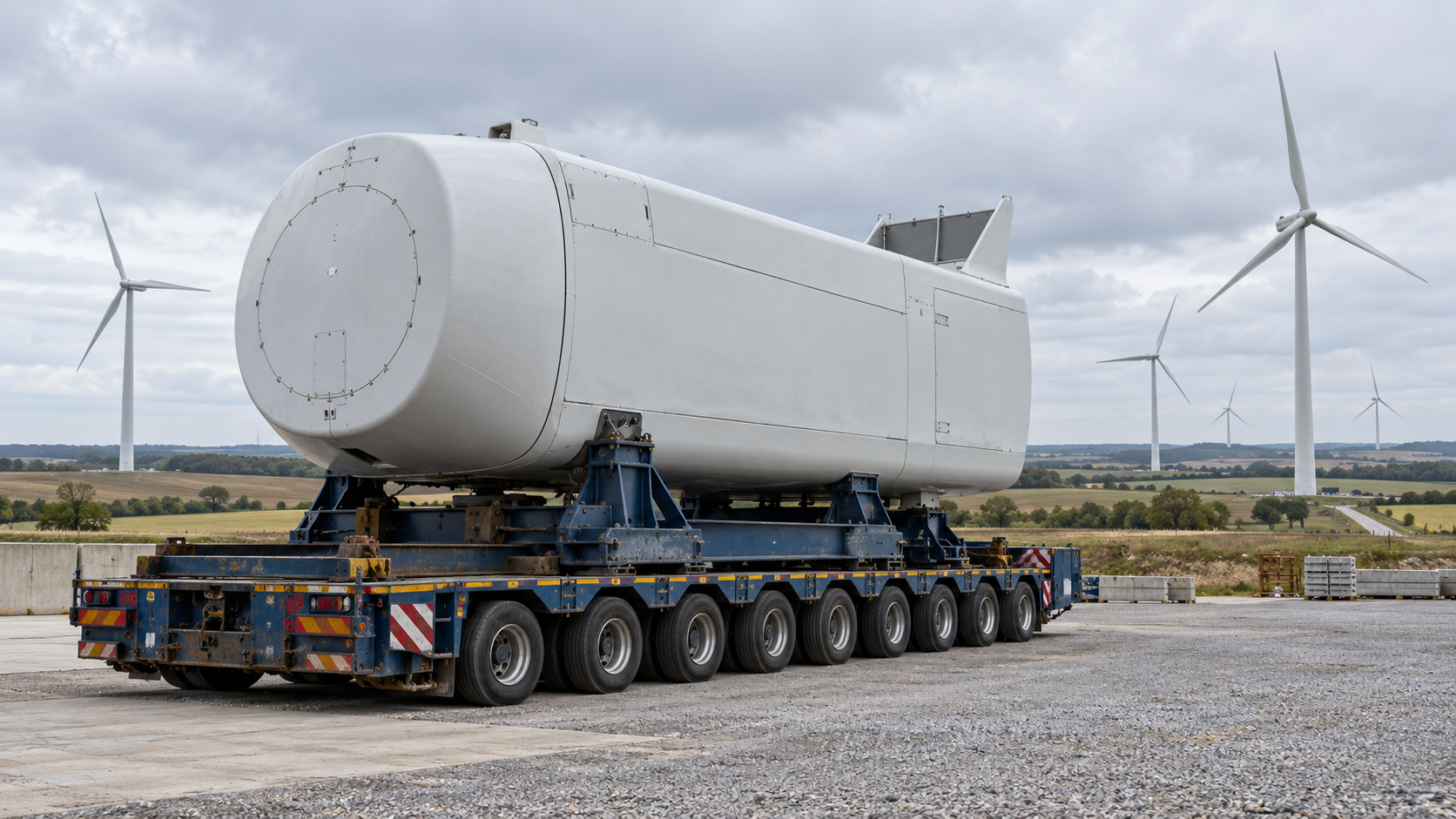
Source checked October 22, 2026. The GE Vernova article is current industry reporting; the cutover-record discussion is NANKMOS editorial guidance, not a manufacturer-approved repowering or commissioning procedure. Featured image: AI-generated generic nacelle transport and wind-farm illustration, not a GE Vernova product or customer-site photograph.
Related guides
View all guides
Machine Vision False Rejects: Check the Lighting Before the Camera
When a reflective part fails inspection, compare reference images before ordering a camera. Learn when to scope the light, controller or mounting instead.
Read guide
AMR Charging Faults: Is the Spare on the Robot or at the Dock?
When an AMR stops charging, distinguish the fixed dock from the vehicle battery. Use dock IDs and fleet events to scope the right replacement RFQ.
Read guide
Servo Drive Spares: EtherCAT Is Not the Encoder Interface
An EtherCAT drive can still be the wrong spare. Learn how to verify the motor encoder protocol, feedback cable and exact drive variant before ordering.
Read guide
CENTUM R7.02: An Estimate Is Not a Field Measurement
Yokogawa’s CENTUM R7.02 adds AI Estimation. See how to distinguish model outputs, transmitter readings and laboratory results before ordering a spare.
Read guideSend your part number, photos or nameplate.
Our team will verify, check availability, and reply with options within 24 hours.
[email protected]+86 18359268345WhatsApp