
Maintenance & RFQ Guides
Schneider Physical AI RFQ for Process Automation: What to Capture Before a Pilot
A practical RFQ guide for process plants evaluating physical AI, digital twins, and data-rich automation, with the control, instrumentation, safety, and data records to capture first.

Physical AI projects in process industries depend on the same plant foundation as ordinary control work: instruments, I/O, controllers, networks, safety functions, and reliable operating data. A pilot can fail at the boundary between those layers if the RFQ describes the AI ambition but omits the installed automation records.
This article uses Schneider Electric’s 8 October 2026 announcement about its planned NVIDIA GTC Berlin 2026 participation as current background. Schneider says it will discuss physical AI across process and heavy industries and AI-powered digital twins using OpenUSD and NVIDIA Omniverse. Those statements describe a direction and an event scope; they do not identify a replacement part or establish site compatibility.
1. Define the process unit and operating boundary
Start with the physical unit that the pilot or replacement will touch: water treatment, batch processing, utilities, chemical handling, energy management, or another process area. Map the control loops, field instruments, remote I/O, control cabinets, operator stations, historians, and safety systems inside that boundary.
Then mark what stays outside the pilot. A data or AI layer may read a process value without owning the control output. A controller replacement may affect safety validation, alarm behavior, historian tags, and operator procedures even when the cabinet footprint is unchanged.
2. Record installed automation and instrumentation precisely
- Controller, remote I/O, communication module, power supply, rack or station, slot, and hardware revision
- Instrument type, range, signal, protocol, hazardous-area requirement, calibration record, and loop number
- Control valve, positioner, drive, actuator, and feedback details where the loop depends on final control elements
- Network topology, device name, IP or address record, redundancy arrangement, and time synchronization source
- Safety controller, safety I/O, interlock, alarm, cause-and-effect, and validation documentation
- Engineering-tool, firmware, configuration, historian, and visualization versions
Family names such as Modicon, EcoStruxure, or a digital-twin platform help identify the conversation, but an actionable RFQ still needs the installed order code, revision, location, and function. A visual match or a platform name alone does not confirm a drop-in replacement.
3. Treat data quality as an automation dependency
For a physical AI or digital-twin pilot, record where each data point originates and how it is delivered. Capture tag name, source controller, scan or update rate, engineering unit, timestamp behavior, quality flag, historian path, and access method. Include examples of normal, bad, stale, and out-of-range values.
Document the interface between the plant network and the data or simulation environment. Identify the gateway, edge computer, protocol, security zone, certificate or account dependency, and the process used to move a tested model or configuration into operation. If OpenUSD or NVIDIA Omniverse is part of the planned workflow, record the model version and ownership boundary separately from the PLC and DCS records.
4. Separate a pilot from a control modification
Ask four separate questions in the RFQ: Is the request for observation only? Does it recommend an operator action? Does it write back to a controller? Does it change a safety or regulatory function? Each answer has a different testing, approval, cybersecurity, and rollback requirement.
For observation-only work, the evidence package may center on read access, tag quality, historian behavior, and network segmentation. For a control modification, include the logic change, interlock impact, validation method, outage window, rollback plan, and responsible engineering party. Do not combine these scopes under a general request for “AI integration.”
5. Prepare the evidence packet
- Clear nameplate, terminal, cabinet, and field-device photos
- Loop drawings, P&IDs, I/O list, control narratives, alarm list, and cause-and-effect records
- Controller, I/O, instrument, drive, HMI, historian, and engineering-software versions
- Network map, security-zone boundary, gateway details, and data-access requirements
- Pilot objective, read/write boundary, acceptance criteria, test environment, and rollback plan
- Required delivery window, documentation, testing, and commissioning constraints
For product identification and technical background, see our industrial automation products and technical resources. Our earlier Schneider RFQ records guide shows the same principle in an electrical automation context. To submit specific identifiers or cabinet records, use the contact page.
Source
Schneider Electric, “Schneider Electric to showcase physical AI for process industries and AI-Ready data center power, cooling and prefab innovations at NVIDIA GTC Berlin 2026,” 8 October 2026. The article uses the announcement as background; NANKMOS does not infer availability, authorization, warranty, or guaranteed compatibility from it.
Related guides
View all guides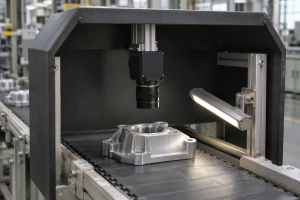
Machine Vision False Rejects: Check the Lighting Before the Camera
When a reflective part fails inspection, compare reference images before ordering a camera. Learn when to scope the light, controller or mounting instead.
Read guide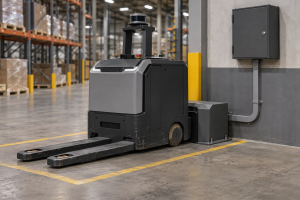
AMR Charging Faults: Is the Spare on the Robot or at the Dock?
When an AMR stops charging, distinguish the fixed dock from the vehicle battery. Use dock IDs and fleet events to scope the right replacement RFQ.
Read guide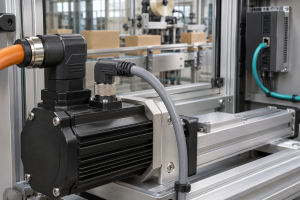
Servo Drive Spares: EtherCAT Is Not the Encoder Interface
An EtherCAT drive can still be the wrong spare. Learn how to verify the motor encoder protocol, feedback cable and exact drive variant before ordering.
Read guide
CENTUM R7.02: An Estimate Is Not a Field Measurement
Yokogawa’s CENTUM R7.02 adds AI Estimation. See how to distinguish model outputs, transmitter readings and laboratory results before ordering a spare.
Read guideSend your part number, photos or nameplate.
Our team will verify, check availability, and reply with options within 24 hours.
[email protected]+86 18359268345WhatsApp