
Maintenance & RFQ Guides
Stored Altivar Drives: Delivery Date Is Not Storage Age
Stored Altivar drives need more than a delivery date. Separate date-code evidence, storage history and model-specific return-to-service review.
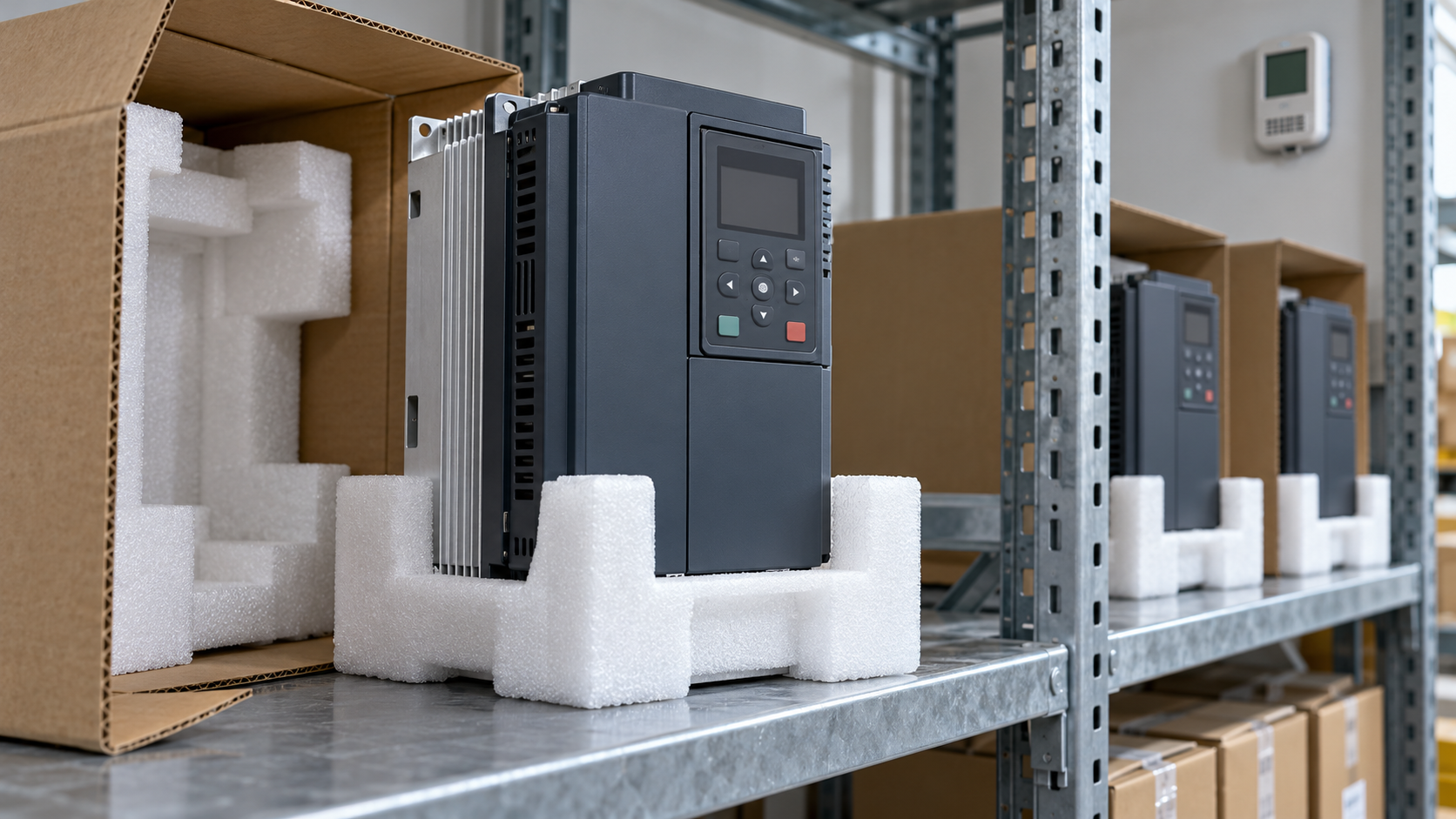
A spare drive can arrive yesterday and still have a much longer storage history. For maintenance planning, the delivery note answers when the unit changed hands. It does not necessarily answer when the drive was manufactured, how it was stored, or whether it is ready for an approved return to service.
This distinction matters when a shutdown plan relies on a shelf spare. The useful question is not simply whether the carton looks clean. It is whether the available evidence supports the particular drive and the intended application.
Why this is a lifecycle issue, not a new product announcement
In an official article dated 27 October 2026, Siemens process-automation leader Axel Lorenz describes modernization as an evolution of existing plants rather than starting again. That is recent industry context, not a drive storage instruction or a statement about any NANKMOS unit.
Our maintenance takeaway is narrower: retaining older equipment also means retaining the knowledge needed to assess its spares. A purchase record and a commissioning decision should remain distinct.
Two Altivar references show why the series matters
Schneider Electric’s ATV61/ATV71 storage FAQ, FA130947, explicitly bases storage time on the product date code rather than the delivery date. Its guidance addresses capacitor reforming after prolonged storage and warns against inappropriate energization.
The separate Altivar Process storage FAQ, FA337087, connects its stated storage periods to storage temperature and refers readers to the relevant installation manual. It is not the same instruction as the ATV61/ATV71 FAQ.
These are existing manufacturer technical references, both showing an April 2026 modification date when checked, not new October releases. Do not transfer one series’ method or timing to another Altivar range, another voltage class, or another manufacturer’s drive. Obtain the current documentation for the exact equipment.
Make the uncertainty visible before the outage
A practical stores review can separate three questions: what the unit is, what is known about its history, and who will approve its intended use. Keeping those questions separate prevents a clear label photograph from being treated as proof of electrical readiness.
For an unidentified unit, capture the complete reference and a readable date-code photograph without opening protective covers. If the meaning of a code is uncertain, record the code as seen and request manufacturer interpretation; do not substitute a guessed manufacture date.
For history, distinguish documented storage conditions from assumptions. An indoor warehouse address is not a temperature record. A recent receipt does not establish the earlier storage environment. Mark missing periods as unknown rather than silently treating them as acceptable.
For readiness, identify the responsible qualified person and the applicable manufacturer document before assigning the spare to a shutdown job. A procurement team can collect evidence, but a quotation cannot replace engineering authorization.
Condition descriptions are not commissioning clearance
Terms such as unused, used or refurbished should describe an agreed supply condition. They should not stand in for a model-specific assessment after storage. Our guide to new, used and refurbished automation parts helps keep the commercial description explicit.
This article is not an energization, capacitor-reforming or fault-finding procedure. Do not apply power, connect a motor, remove covers or attempt a test based on this blog. Qualified personnel must follow the current manufacturer instructions and the site’s electrical-safety and isolation procedures. If the necessary history or documentation is unavailable, escalate the decision rather than improvising a test.
Ask for a defined part, not an implied guarantee
When reviewing industrial automation spare parts, keep the exact reference, requested condition and unresolved history questions together. Use the NANKMOS inquiry form to share those details and request confirmation of the available unit’s records. Availability, condition evidence and suitability remain subject to RFQ review; a matching reference alone is not a promise of immediate installation readiness.
Related guides
View all guides
Machine Vision False Rejects: Check the Lighting Before the Camera
When a reflective part fails inspection, compare reference images before ordering a camera. Learn when to scope the light, controller or mounting instead.
Read guide
AMR Charging Faults: Is the Spare on the Robot or at the Dock?
When an AMR stops charging, distinguish the fixed dock from the vehicle battery. Use dock IDs and fleet events to scope the right replacement RFQ.
Read guide
Servo Drive Spares: EtherCAT Is Not the Encoder Interface
An EtherCAT drive can still be the wrong spare. Learn how to verify the motor encoder protocol, feedback cable and exact drive variant before ordering.
Read guide
CENTUM R7.02: An Estimate Is Not a Field Measurement
Yokogawa’s CENTUM R7.02 adds AI Estimation. See how to distinguish model outputs, transmitter readings and laboratory results before ordering a spare.
Read guideSend your part number, photos or nameplate.
Our team will verify, check availability, and reply with options within 24 hours.
[email protected]+86 18359268345WhatsApp