
Maintenance & RFQ Guides
Plan an HMI Replacement Around the Application
An HMI replacement needs more than matching hardware. Separate runtime files from editable projects and confirm recovery limits before planning a change.
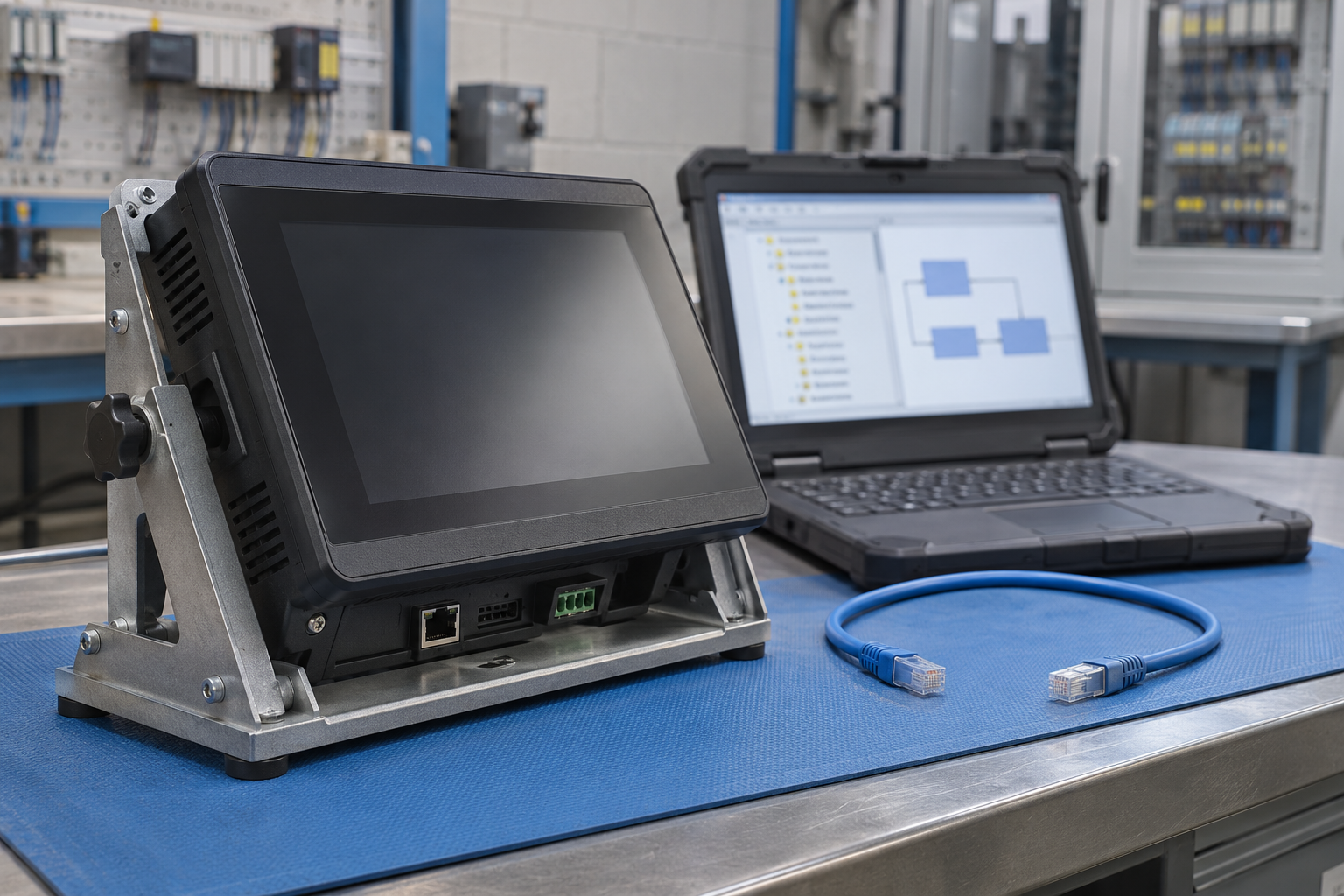
A replacement HMI may fit the panel cutout and still leave a machine without its operator interface. The missing piece can be the application rather than the display. Before treating a terminal as a straightforward spare, establish what software can actually be recovered, who owns it, and how the proposed replacement will be validated.
New HMI capabilities do not make existing applications portable
In its November 3, 2026 SPS announcement, Advantech described planned demonstrations of software-defined automation and next-generation HMI with edge AI and remote visualization. SPS is scheduled for November 24–26 in Nuremberg; these are announced demonstrations, not a completed event.
For maintenance teams, our practical takeaway is to keep the hardware decision separate from the application decision. News about more capable interfaces does not establish that an existing project will run on another terminal, platform, or vendor’s software. It also does not establish that a failed terminal’s application can be reconstructed.
A runtime file is not the same promise as an editable project
Consider a concrete, vendor-specific example. Rockwell Automation’s FactoryTalk View ME version 16 help on runtime restoration describes creating a development application file (.med) from a version 5.00 or later runtime file (.mer). The documented operation does not apply to runtime files created before version 5.00.
The same documentation explains that runtime files can have permanent conversion protection or require a password. Permanently protected files cannot be converted into development applications. It also distinguishes the restored runtime communications configuration from the original engineering workstation’s communications topology: the latter is not restored by runtime conversion.
Those are FactoryTalk View ME boundaries, not universal rules for every HMI. They are a useful reason to avoid the broad promise that having a runtime file means having a recoverable engineering project. A password requirement should go back to the authorized project owner, not become a request to bypass protection.
Describe the recovery position before choosing the change
Two otherwise similar terminals can present very different maintenance situations. One plant may hold a current, editable project with a known engineering environment. Another may hold only a runtime file of uncertain origin. A third may have no verified copy outside the failed device. Those situations should not receive the same replacement plan or downtime assumption.
A useful maintenance handover distinguishes the files that are available from the recovery work that has actually been demonstrated. Record the known application version, the source and date of the last verified project copy, and any unresolved access or conversion restrictions. An old file on a shared drive is evidence to investigate, not proof that the current machine can be restored from it.
Hardware identity still matters. Capture the full terminal identification and revision rather than relying on a photograph of its front bezel. Our nameplate identification guide explains the broader discipline of recording complete industrial part identifiers; HMI-specific selection must still follow the relevant manufacturer’s documentation.
Keep the sourcing decision and engineering acceptance distinct
Use the NANKMOS product catalogue to identify the hardware you want to enquire about. A matching model reference is a starting point for sourcing, not approval to deploy an application or substitute a different platform.
Before a production change, the responsible engineering team should define a controlled validation plan appropriate to the machine. That may include checking the project in an authorized offline environment and reviewing communications, operator functions, alarms, and any site-specific dependencies. This article is planning guidance, not a download, commissioning, or safety acceptance procedure.
For an HMI-related RFQ, send the complete hardware reference and a short description of the application-recovery position. Keep source projects, passwords, network details, and other sensitive engineering material within your approved sharing process. NANKMOS can receive the parts enquiry; application recovery feasibility and machine acceptance remain separate engineering decisions. Availability, condition, and commercial terms must be confirmed for the individual enquiry.
Image: AI-generated illustration of a generic, isolated HMI maintenance bench. It does not show a specific manufacturer’s terminal, software interface, approved recovery procedure, or NANKMOS stock.
Sources checked November 4, 2026. The Advantech announcement supplies the current news context. The Rockwell page is a technical reference, not a newly announced release.
Related guides
View all guides
Machine Vision False Rejects: Check the Lighting Before the Camera
When a reflective part fails inspection, compare reference images before ordering a camera. Learn when to scope the light, controller or mounting instead.
Read guide
AMR Charging Faults: Is the Spare on the Robot or at the Dock?
When an AMR stops charging, distinguish the fixed dock from the vehicle battery. Use dock IDs and fleet events to scope the right replacement RFQ.
Read guide
Servo Drive Spares: EtherCAT Is Not the Encoder Interface
An EtherCAT drive can still be the wrong spare. Learn how to verify the motor encoder protocol, feedback cable and exact drive variant before ordering.
Read guide
CENTUM R7.02: An Estimate Is Not a Field Measurement
Yokogawa’s CENTUM R7.02 adds AI Estimation. See how to distinguish model outputs, transmitter readings and laboratory results before ordering a spare.
Read guideSend your part number, photos or nameplate.
Our team will verify, check availability, and reply with options within 24 hours.
[email protected]+86 18359268345WhatsApp