
Product Systems
Identify the Protocol Behind an Industrial Ethernet Port
For PLC and DCS communication spares, match the installed protocol and device function, not just the connector. TI's new module shows why software matters.
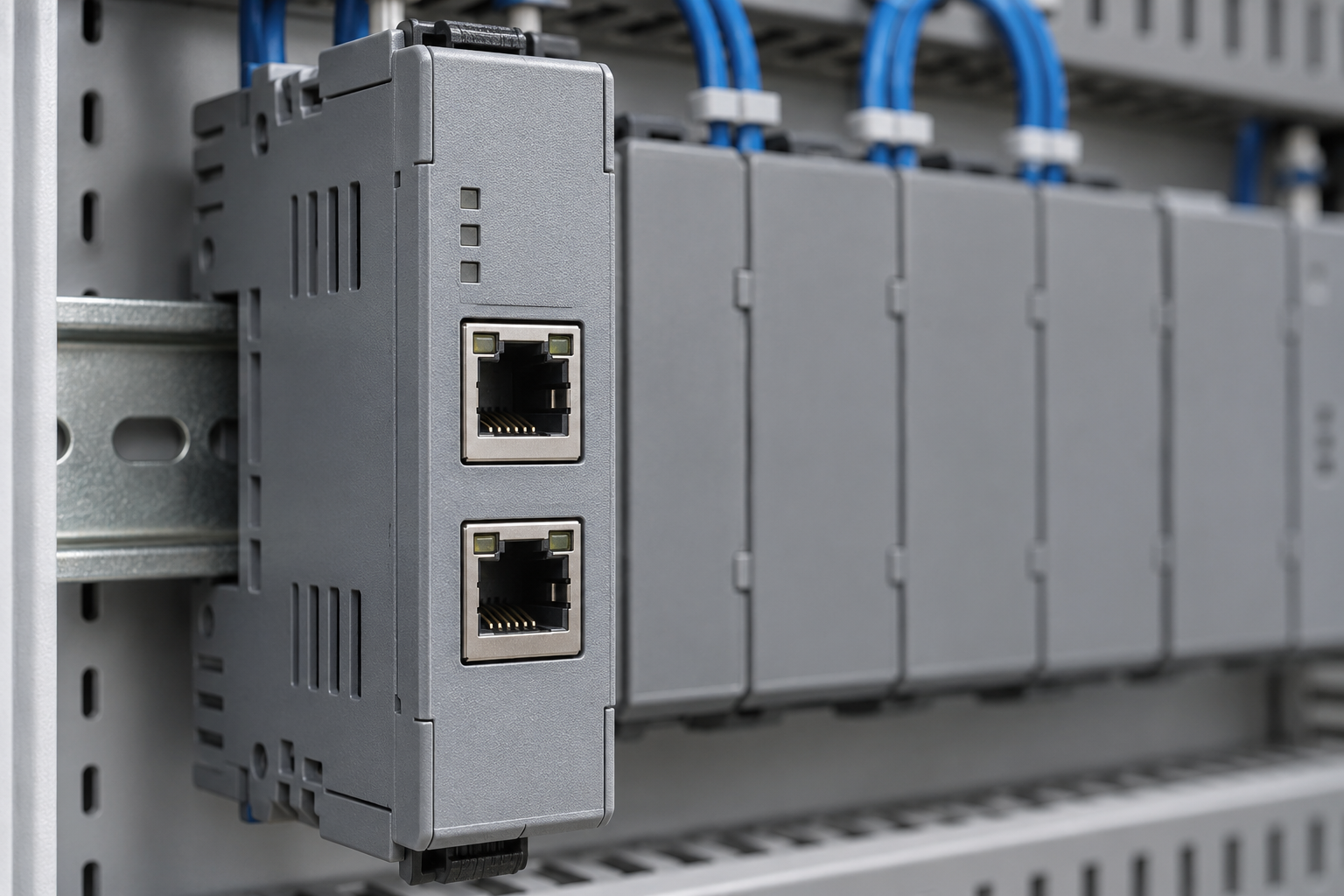
A clear photograph of two Ethernet sockets can help identify the physical interface on an automation module. It cannot establish the industrial protocol the installed device is running, or the role it performs in the control system. That distinction matters when a communication module becomes a replacement-parts enquiry.
One hardware platform, different protocol software
On November 5, 2026, Texas Instruments announced the TICS100MOD communications system-on-module. TI describes support for EtherCAT, EtherNet/IP, and PROFINET on the same hardware, with protocol switching at boot through a firmware update. The announcement states availability by year-end 2026; it is not a statement that the module is already stocked by NANKMOS.
This is an embedded design component, not an announced drop-in replacement for an existing PLC or DCS communication card. Its relevance to maintenance is the distinction it makes visible: hardware appearance and protocol capability are related, but they are not the same identification.
Keep the connector and the application protocol separate
ODVA’s EtherNet/IP technology overview explains that EtherNet/IP uses the Common Industrial Protocol, CIP, at its upper layers. It describes the network in terms of several communication layers rather than the connector alone. This is established technical background, not a new November release.
Our maintenance interpretation is straightforward. A matching socket, a familiar cable, or the word “Ethernet” on a description does not demonstrate that a proposed spare supplies the required industrial communication function. An enquiry should distinguish the physical interface, the supported protocol, and the function required by the installed application.
For example, a generic description such as “two-port Ethernet module” leaves open whether the item is a network interface, an I/O adapter, a gateway, or another device. It also leaves the active protocol unresolved. These are questions to settle from the exact product documentation and approved installed records, not from an unlabelled front-panel photograph.
Available protocols are different from the installed protocol
A manufacturer’s list of supported protocols describes capabilities under the stated product conditions. It does not identify the firmware and configuration of a particular unit already on a machine. For a multiprotocol product, the installed software context belongs with the hardware identity in the maintenance record.
A useful starting point is the complete model and option reference, the hardware revision where identified, and the known firmware or protocol variant. Our guide to reading industrial module nameplates explains why a complete part reference is more useful than a shortened family name. The applicable communication function still needs confirmation from the relevant manufacturer’s documents.
Use existing approved engineering records or the site’s authorized inspection process to resolve missing details. Do not change a device’s firmware, connect unfamiliar equipment to a production network, or switch its protocol just to establish what it is. The TI announcement describes an engineering capability; it is not a field-maintenance instruction for another manufacturer’s installed equipment.
The same protocol name is another starting point, not final approval
Once the protocol is identified, the replacement review still has to address the device’s intended function and the host system’s requirements. Supporting a protocol does not, on its own, establish the application data, supported features, or revision combinations expected by the installed project.
The practical handover is therefore more specific than “Ethernet compatible.” It states the identified device and the required protocol and function, while making any unresolved compatibility question visible. If the engineering review is incomplete, keep that status distinct from a confirmed replacement requirement.
The NANKMOS product catalogue can support an enquiry for an identified communication module. Send the complete reference and confirmed application requirement for an individual RFQ. Availability, condition, revision details, and commercial terms require confirmation. Hardware sourcing does not replace the machine owner’s approval of a network-device substitution.
Image: AI-generated illustration of generic industrial Ethernet ports in an isolated training cabinet. It is not a TI product photograph, a validated wiring layout, or evidence of a particular protocol.
Sources checked November 7, 2026. TI’s November 5 announcement provides current news context; ODVA provides the protocol reference.
Related guides
View all guides
Machine Vision False Rejects: Check the Lighting Before the Camera
When a reflective part fails inspection, compare reference images before ordering a camera. Learn when to scope the light, controller or mounting instead.
Read guide
AMR Charging Faults: Is the Spare on the Robot or at the Dock?
When an AMR stops charging, distinguish the fixed dock from the vehicle battery. Use dock IDs and fleet events to scope the right replacement RFQ.
Read guide
Servo Drive Spares: EtherCAT Is Not the Encoder Interface
An EtherCAT drive can still be the wrong spare. Learn how to verify the motor encoder protocol, feedback cable and exact drive variant before ordering.
Read guide
CENTUM R7.02: An Estimate Is Not a Field Measurement
Yokogawa’s CENTUM R7.02 adds AI Estimation. See how to distinguish model outputs, transmitter readings and laboratory results before ordering a spare.
Read guideSend your part number, photos or nameplate.
Our team will verify, check availability, and reply with options within 24 hours.
[email protected]+86 18359268345WhatsApp